
Phaedon laevigatus
(Duftschmid, 1825)
watercress leaf beetle
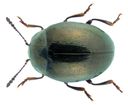
Phaedon laevigatus, commonly known as the watercress leaf beetle, is a leaf beetle in the Chrysomelidae. The has a transcontinental distribution spanning Europe, Northern Asia (excluding China), and North America. It is associated with watercress and related plants in the family Brassicaceae. The specific epithet 'laevigatus' refers to the smooth or polished appearance of the .
Pronunciation
How to pronounce Phaedon laevigatus: //ˈfiːdɒn ˌlæ.vɪˈɡeɪ.təs//
These audio files are automatically generated. While they are not always 100% accurate, they are a good starting point.
Identification
The can be distinguished from other Phaedon species by the smooth, polished appearance of the (reflected in its specific epithet). Within the Phaedon, identification to species level typically requires examination of elytral , punctation patterns, and coloration. Confirmation may require comparison with or expert determination.
Images
Habitat
Associated with aquatic or semi-aquatic environments where its plants grow. Found in supporting watercress and related Brassicaceae , including streamsides, springs, and wet meadows.
Distribution
Europe; Northern Asia (excluding China); North America. Specific records include the province of Alberta, Canada.
Diet
Larvae and feed on watercress (Nasturtium officinale) and related plants in the Brassicaceae. This association is reflected in the 'watercress leaf beetle'.
Host Associations
- Nasturtium officinale - food plantwatercress; primary implied by
- Brassicaceae - food plant containing watercress and related plants
Ecological Role
Herbivore specializing on aquatic Brassicaceae. As a leaf-feeding beetle, it contributes to nutrient cycling and may influence plant composition in wetland .
Human Relevance
May be of minor economic concern in watercress . The suggests recognition as a pest of this commercially grown aquatic crop.
Similar Taxa
- Phaedon armoraciaealso associated with Brassicaceae ; may overlap in and host use
- Phaedon cochleariaecongeneric with similar ; identification requires careful examination of elytral
More Details
Etymology
The specific epithet 'laevigatus' is derived from Latin, meaning 'smoothed' or 'polished', referring to the characteristic smooth of this .
Taxonomic history
Originally described as Chrysomela laevigata by Duftschmid in 1825, later transferred to the Phaedon.