
Sumitrosis rosea
(Weber, 1801)
leafminer beetle
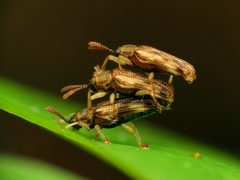
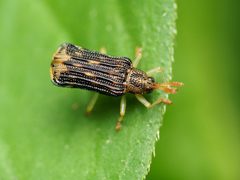
Sumitrosis rosea is a small leaf-mining in the Chrysomelidae, commonly known as the leafminer beetle. measure 3.3–4.5 mm and exhibit highly variable coloration, with ranging from pale yellow with faint black markings to black with faint yellow spots. The is native to North America and has been documented feeding on a range of plants, particularly in the family Fabaceae.
Pronunciation
How to pronounce Sumitrosis rosea: /suːˈmɪtɹoʊsɪs ˈɹoʊziə/
These audio files are automatically generated. While they are not always 100% accurate, they are a good starting point.
Identification
are distinguished by their small size (3.3–4.5 mm) and the highly variable coloration of the . The combination of small stature, variable yellow-to-black patterning, and association with leaf-mining damage on Fabaceae aids in field identification. Separation from other Sumitrosis and related chrysomelids requires examination of genitalia or other fine morphological characters.
Images
Habitat
Occurs in a variety of environments including agricultural fields, particularly soybean crops, and natural or semi-natural supporting its plants. Associated with areas where Fabaceae grow.
Distribution
North America. Recorded from Canada (Manitoba, New Brunswick, Nova Scotia, Ontario, Prince Edward Island, Quebec, Saskatchewan) and the United States (Alabama, Arizona, Arkansas, Connecticut, Delaware, District of Columbia, Florida, Georgia, Illinois, Indiana, Iowa, Kansas, Kentucky, Louisiana, Maine, Maryland, Michigan, Minnesota, Mississippi, Missouri, New Jersey, New York, North Carolina, Ohio, Oklahoma, Pennsylvania, South Carolina, Tennessee, Texas, Vermont, Virginia, West Virginia, Wisconsin, Wyoming).
Diet
and larvae feed on foliage of various Fabaceae , especially Robinia pseudoacacia and Desmodium species. Has also been observed on plants from other including Celastrus orbiculatus (Celastraceae) and Centrosema pubescens (Fabaceae). Documented as a pest of soybean (Glycine max).
Host Associations
- Robinia pseudoacacia - Preferred
- Desmodium - Preferred
- Glycine max - Soybean; agricultural pest association
- Celastrus orbiculatus - Non-fabaceous
- Centrosema pubescens -
Behavior
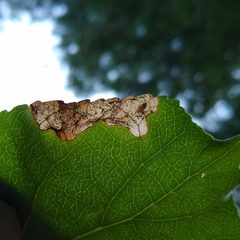
Larvae are leaf miners, creating feeding tunnels within leaf tissue. have been collected from plants in various , suggesting some mobility among .
Ecological Role
Herbivore; . Functions as a primary consumer on leguminous and other plants. In agricultural contexts, acts as a pest of soybean crops.
Human Relevance
Recognized as an agricultural pest of soybean (Glycine max), with potential economic impact in soybean-growing regions.
Similar Taxa
- Other Sumitrosis speciesSimilar size and general ; require detailed examination for definitive identification
- Other Cassidinae leaf minersShared leaf-mining habit and small size; associations and fine morphological characters aid separation
More Details
Taxonomic history
Originally described by Weber in 1801. Placed in tribe Chalepini within Cassidinae of Chrysomelidae.
Research note
A 1984 study in Journal of Economic Entomology documented soybean as a , expanding the known agricultural relevance of this beyond native Fabaceae hosts.
Sources and further reading
- BugGuide
- Wikipedia
- GBIF taxonomy match
- iNaturalist taxon
- NCBI Taxonomy
- Catalogue of Life
- She’s a Peach of a Permanent Resident | Bug Squad
- Oh, the Bugs They Saw at the Bohart! | Bug Squad
- Hissers: Big, Bold and Beautiful | Bug Squad
- Bohart Museum Open House on 'Many Legged Wonders': How Many Legs Does an Isopod Have? | Bug Squad
- UC Davis Picnic Day: Let's Go on an Insect Scavenger Hunt! | Bug Squad
- 'A Water Leak' That Turned Into a Surprise Birthday Party | Bug Squad
- Soybean as a Host for the Leafminer Sumitrosis rosea (Coleoptera: Chrysomelidae)