
Sumitrosis inaequalis
(Weber, 1801)
Sumitrosis inaequalis is a small leaf beetle in the Chrysomelidae, Cassidinae. measure 3.4–4.2 mm and exhibit highly variable coloration, ranging from pale yellow with faint markings to predominantly black with yellow spots. The is distributed across Central America and much of North America, with records from Canada and the United States. It is a , feeding internally on plant foliage.
Pronunciation
How to pronounce Sumitrosis inaequalis: //ˌsuːmɪtˈroʊsɪs ɪnəˈkwɑːlɪs//
These audio files are automatically generated. While they are not always 100% accurate, they are a good starting point.
Identification
Distinguished from similar leaf beetles by its small size (under 5 mm), highly variable coloration, and association with specific plants. The pronotal and elytral pattern variation can make identification challenging; examination of genitalia or association with known hosts may be necessary for definitive identification.
Images
Appearance
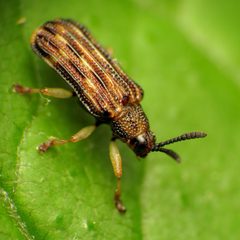
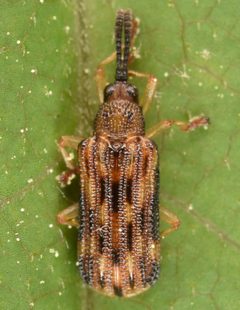
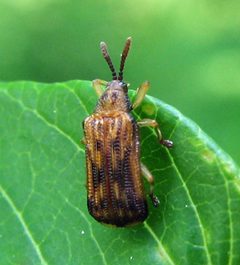
are small beetles, 3.4–4.2 mm in length. Coloration is highly variable. The pronotum ranges from pale to maculate with (dark brown to black) markings. vary from pale yellow with faint black markings to black with faint yellow spots.
Habitat
Associated with plants in various terrestrial . Specific microhabitat preferences beyond host plant presence are not well documented.
Distribution
Central America and North America. In North America, recorded from Canada (Alberta, British Columbia, Manitoba, New Brunswick, Nova Scotia, Ontario, Quebec, Prince Edward Island, Saskatchewan) and the United States (Alabama, Arizona, Arkansas, California, Colorado, Connecticut, Delaware, Florida, Georgia, Illinois, Indiana, Iowa, Kansas, Kentucky, Louisiana, Maine, Maryland, Massachusetts, Michigan, Minnesota, Mississippi, Missouri, Montana, Nebraska, New Hampshire, New Jersey, New York, North Carolina, Ohio, Oklahoma, Pennsylvania, Rhode Island, South Carolina, Tennessee, Texas, Utah, Vermont, Virginia, West Virginia, Wisconsin, Wyoming).
Diet
. plants include Eurybia divaricata (white wood aster), Symphyotrichum cordifolium (blue wood aster), and Ambrosia artemisiifolia (common ragweed). Larvae feed internally within leaf tissue.
Host Associations
- Eurybia divaricata - plantleaf mining
- Symphyotrichum cordifolium - plantleaf mining
- Ambrosia artemisiifolia - plantleaf mining
Ecological Role
Herbivore. As a , larvae feed between leaf surfaces, creating internal feeding galleries. Specific ecological impacts or interactions beyond herbivory are not documented.
Similar Taxa
- Other Sumitrosis speciesCongeneric share similar size and general body form; identification requires examination of specific morphological characters or associations.
- Other Cassidinae leaf minersSimilar leaf mining habit and small size; plant specificity and detailed examination of elytral and pronotal patterns may be needed for separation.
Sources and further reading
- BugGuide
- Wikipedia
- GBIF taxonomy match
- iNaturalist taxon
- NCBI Taxonomy
- Catalogue of Life
- Bug Eric: Moth Monday: Palo Verde Webworm
- Bug Eric: The Beetle and the Bee
- Spring sunshine heralds the appearance of plasterer bees: Colletes — Bug of the Week
- Spring arrives and with it, delightful Plasterer bees: Colletes spp. — Bug of the Week
- Bug of the Week