
Merobruchus
Bridwell, 1946
pea and bean weevils
Species Guides
5- Merobruchus insolitus(White Dart Bruchid)
- Merobruchus julianus
- Merobruchus major(Texas ebony bruchid)
- Merobruchus terani
- Merobruchus vacillator
Merobruchus is a of seed beetles in the Bruchinae (Chrysomelidae) comprising approximately 25 distributed primarily in the Neotropical Region. These beetles are distinguished from other bruchines by projections on the last abdominal ventrite of females and some males. The genus exhibits considerable morphological variation in both external features and male genitalia, with some species being difficult to distinguish based on coloration and patterns alone. Merobruchus species are specialized seed feeders associated primarily with legumes in the subfamily Mimosoideae.
Pronunciation
How to pronounce Merobruchus: //ˌmɛroʊˈbruːkəs//
These audio files are automatically generated. While they are not always 100% accurate, they are a good starting point.
Identification
Primary diagnostic feature is the presence of projections on the last abdominal ventrite, visible in females of all and males of some species. Species-level identification requires examination of male genitalia due to considerable similarity in external coloration and patterns among some species. habitus, structure, and male genital are all used in combination for accurate determination. The is placed in the tribe Acanthoscelidina, group Merobruchus.
Images
Appearance
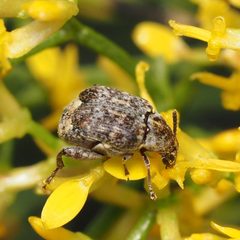
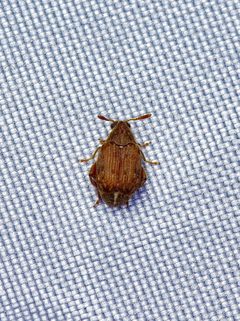
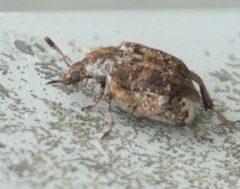
Small to medium-sized seed beetles with compact, somewhat oval bodies. The is characterized by projections on the last abdominal ventrite () of females and some males—a diagnostic feature distinguishing Merobruchus from all other bruchine genera. surface with variable coloration and patterns, ranging from uniform to distinctly patterned. Male genitalia show substantial interspecific variation. Body form typical of Bruchinae, with shortened that may expose part of the .
Habitat
Associated with seeds of leguminous plants, primarily in the Mimosoideae. Found in where plants occur, including native forests and areas with legume trees.
Distribution
New World distribution, concentrated in the Neotropical Region. Documented from Colombia and Brazil (Rio Grande do Sul), with records extending to areas where plants have been introduced.
Diet
Specialized seed feeder. Larvae develop within seeds of plants. Documented hosts include Mimosoideae (tribes Acacieae, Ingeae, Mimoseae), with records from Acacia, Inga, and related . Also recorded from Caesalpinioideae: Parapiptadenia rigida, Pterogyne nitens, and Senna neglecta.
Host Associations
- Acacieae (Mimosoideae) - larval development in seeds
- Ingeae (Mimosoideae) - larval development in seeds
- Mimoseae (Mimosoideae) - larval development in seeds
- Parapiptadenia rigida - larval development in seedsnew record for Bruchinae
- Pterogyne nitens - larval development in seedsnew record for Bruchinae; Caesalpinioideae
- Senna neglecta - larval development in seedsCaesalpinioideae
- Leucaena leucocephala - larval development in seeds ; first record for M. paquetae
- Pseudosamanea guachapele - larval development in seedsnative for M. paquetae in Colombia
Ecological Role
Seed specializing on leguminous plants. Acts as a natural enemy of native and introduced Mimosoideae. Potential for biocontrol of legumes such as Leucaena leucocephala, though this has not been formally evaluated.
Human Relevance
Potential significance for of legume trees. The association of Merobruchus paquetae with the highly invasive Leucaena leucocephala suggests possible utility in managing this , though deliberate introduction would require careful risk assessment.
Similar Taxa
- AcanthoscelidesBoth belong to tribe Acanthoscelidina and share general bruchine ; distinguished by the pygidial projections unique to Merobruchus
- PseudopachymerusFormerly treated as separate , now synonymized under Merobruchus; were historically confused due to similar external appearance
More Details
Taxonomic history
established by Bridwell in 1946. Formerly included Pseudopachymerus, which has been synonymized. The group Merobruchus within Acanthoscelidina is defined by the pygidial projection character.
Identification challenges
-level identification is complicated by convergent similarity in coloration and among unrelated species. Published keys rely heavily on male genitalia and structure.
Sources and further reading
- BugGuide
- Wikipedia
- GBIF taxonomy match
- iNaturalist taxon
- NCBI Taxonomy
- A key to American genus Merobruchus Bridwell (Coleoptera: Chrysomelidae: Bruchinae) with descriptions of species and two new host plant records for the subfamily
- First record of the seed beetle <i>Merobruchus paquetae</i> (Chrysomelidae, Bruchinae) in the exotic tree <i>Leucaena leucocephala</i>