
Lepturobosca chrysocoma
(Kirby, 1837)
Yellow velvet beetle, Golden flower longhorn beetle, Golden-haired flower longhorn
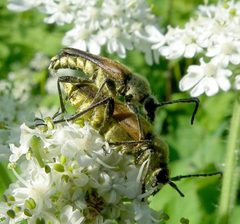
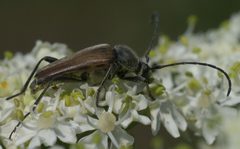
Lepturobosca chrysocoma is a of longhorn beetle in the Cerambycidae, characterized by its dense coat of golden hairs that gives rise to its . The species was originally described as Cosmosalia chrysocoma by William Kirby in 1837, but was reassigned to Lepturobosca in 1998 based on morphological comparisons by Russian entomologist Alexander Ivanovich Miroshnikov. are frequently observed feeding on flowers during summer months, where they function as by transferring pollen on their hairy bodies. Larvae develop in decaying wood of trees including black spruce (Picea mariana) and poplars (Populus).

Pronunciation
How to pronounce Lepturobosca chrysocoma: /lɛptʊˈroʊbɒska krɪsoʊˈkoʊmə/
These audio files are automatically generated. While they are not always 100% accurate, they are a good starting point.
Identification
The combination of small size (10–20 mm), dense golden-yellow hair covering, and flower-visiting in summer distinguishes this from most other North American longhorn beetles. The hairy appearance separates it from the related Lepturobosca virens, which has greenish coloration. may be confused with other flower-visiting cerambycids, but the uniform golden is distinctive.
Images
Habitat
are found in with abundant flowering vegetation. Larval habitat consists of decaying wood in forested areas. The occurs in a variety of forest and woodland types across its broad geographic range, from forests to more temperate deciduous woodlands.
Distribution
North America: Canada (British Columbia, Alberta, Saskatchewan, Manitoba, Ontario, Quebec, New Brunswick, Nova Scotia, Newfoundland, Prince Edward Island, Northwest Territories, Yukon Territory) and United States (Montana, Wyoming). Records also indicate presence in Middle America and Vermont.
Seasonality
are active in summer, with peak activity during flowering periods. The has been observed from May through summer months, with adult timed to coincide with peak flower availability.
Diet
feed on flower nectar and pollen. Larvae feed on decaying wood of trees, specifically documented from Picea mariana (black spruce) and Populus (poplars).
Host Associations
- Picea mariana - larval decaying wood
- Populus - larval decaying wood
Life Cycle
Complete with , larval, pupal, and stages. Larvae develop in decaying wood, feeding on the decomposing wood tissue. Adults emerge in summer and are frequently observed on flowers. The is a known for the parasitic wasp Coleocentrus quebecensis ( Acaenitinae), which presumably attacks the larval or pupal stages.
Behavior
are and frequently observed feeding on flowers. Their hairy bodies pick up pollen during feeding, and this pollen is transferred to other flowers, facilitating pollination. Adults are active fliers and readily move between flowering plants.
Ecological Role
function as of flowering plants through incidental pollen transfer on their hairy bodies. Larvae contribute to wood decomposition and nutrient cycling in forest . The serves as a for , contributing to complexity.
Human Relevance
No significant economic impact documented. The is of interest to entomologists and naturalists due to its distinctive appearance and role. Specimens are commonly collected and preserved in entomological collections, where the species has been subject to taxonomic revision and discussion regarding identification label practices.
Similar Taxa
- Lepturobosca virensSimilar and , but distinguished by greenish coloration rather than golden-yellow ; the 1998 comparison of these two led to the merger of Cosmosalia into Lepturobosca
More Details
Taxonomic History
The has undergone significant taxonomic revision. Originally described as Cosmosalia chrysocoma by William Kirby in 1837, it was retained in that for over 150 years. In 1998, Russian entomologist Alexander Ivanovich Miroshnikov compared Cosmosalia chrysocoma with Lepturobosca virens and concluded that the two genera should be merged under Lepturobosca, with chrysocoma becoming the type species of the expanded genus. This revision is reflected in collection practices, where older specimens may bear labels with the former genus name.
Collection and Curation Notes
The has been used as an example in discussions of entomological collection practices, specifically regarding identification labels. When the was changed from Cosmosalia to Lepturobosca, curators debated whether to update labels on existing specimens. The consensus approach, exemplified by this species, is to retain original identification labels as historical records of taxonomic opinion while adding new labels to reflect current .