
Mesosini
Genus Guides
1- Synaphaeta(Spotted Tree Borer)
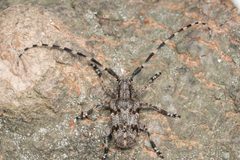
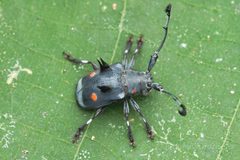
Mesosini is a tribe of longhorn beetles (Cerambycidae) within the Lamiinae. The tribe contains approximately 60 described distributed primarily across East Asia, Southeast Asia, and parts of the Oriental region. Members are characterized by morphological traits typical of Lamiinae, with some genera exhibiting distinctive features such as elytral or modified . The tribe includes economically significant associated with hardwood trees.
Pronunciation
How to pronounce Mesosini: //ˌmɛsəˈsaɪnaɪ//
These audio files are automatically generated. While they are not always 100% accurate, they are a good starting point.
Identification
Members of Mesosini can be distinguished from other Lamiinae tribes by a combination of morphological characters, though specific diagnostic features vary by . The genus Eurymesosa is characterized by an elongated oval robust body, strongly (kidney-shaped) , with two large oblique bumps behind the middle of the base, and a mesosternal process with a single central . in length has been documented in some genera: males with antennae more than half the body length, females with antennae about one-quarter longer than the body.
Images
Distribution
The tribe has a broad distribution across East Asia, Southeast Asia, and parts of the Oriental region. Individual show varying ranges: Eurymesosa occurs in Cambodia, China, Indonesia (Borneo), Laos, Malaysia (Peninsular Malaysia and Borneo), and Vietnam; Clyzomedus pani is known from Beijing, Shaanxi, Henan, and Anhui provinces in China.
Host Associations
- Quercus acutissima - possible Recorded for Clyzomedus pani; noted as 'possible plant' indicating uncertainty
Human Relevance
Some have potential economic significance as pests or indicators of forest health due to associations with hardwood trees. The discovery of Clyzomedus pani in Beijing was part of a formal Biodiversity Survey and Assessment Project, demonstrating the tribe's relevance to regional biodiversity documentation.
Similar Taxa
- Other Lamiinae tribesMesosini shares the general Lamiinae characteristics of rounded and often cryptic coloration; specific tribal assignment requires examination of genitalic and other detailed morphological characters