
Stenopterini
Genus Guides
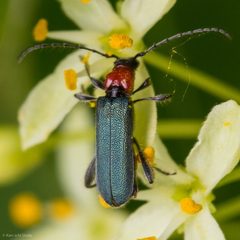
1- Callimoxys(blood-necked longhorn (for C. sanguinicollis))
Stenopterini is a tribe of longhorn beetles in the Cerambycinae. The tribe contains approximately 10 , including Stenopterus, Callimoxys, and Merionoeda. Some exhibit in coloration and possess distinctly swollen hind . At least one species has been documented as a flower visitor and potential .


Pronunciation
How to pronounce Stenopterini: /stɛnˌɒptəˈraɪnaɪ/
These audio files are automatically generated. While they are not always 100% accurate, they are a good starting point.
Identification
Members of Stenopterini may be recognized by distinctly swollen hind in some . in coloration has been observed, with males and females showing different pronotal and prosternal pigmentation. Hind legs are densely pubescent with long setae in at least some species.
Images
Distribution
The tribe has a broad distribution including Europe, Asia, and North America. The Stenopterus occurs in Europe and North Africa. Merionoeda has been recorded from China, Japan, Taiwan, and South Korea. Callimoxys are found in North America and Europe.
Seasonality
in at least one (Merionoeda hirsuta) begins in early July in the southern Korean Peninsula. Activity is highest in warm, clear weather conditions.
Host Associations
- Mallotus japonicus - flower visitationMale flowers visited by Merionoeda hirsuta; males visit approximately ten times more frequently than females
Behavior
Flower visitation has been documented in at least one , with males visiting flowers approximately ten times more frequently than females. Beetles are most active in warm, clear weather. Swarming with high densities has been observed, with 139 individuals captured in a few hours at a single location.
Ecological Role
Potential visitation to male flowers of Mallotus japonicus.
More Details
Included Genera
The tribe contains the following : Callimoxys, Callimus, Guerryus, Holangus, Kunbir, Merionoeda, Microdebilissa, Obscuropterus, and Stenopterus. A fossil , †Callimoxys primordialis, is known from the Miocene.
Sexual Dimorphism
In Merionoeda hirsuta, males are black while females show orange coloration on the pronotum, , and scutellum. Males also outnumber females approximately 10:1 at flowers.