
Icosium
Lucas, 1854
Species Guides
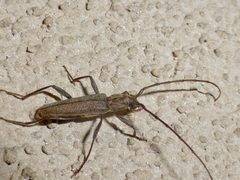
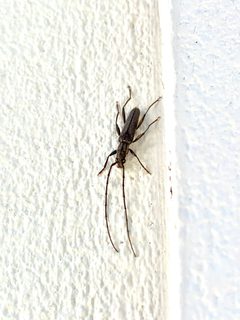
1Icosium is a of longhorn beetles (Cerambycidae: Cerambycinae) established by Lucas in 1854, containing the single Icosium tomentosum. The genus is notable for the unique acoustic of its larvae, which produce substrate-borne vibrations audible to humans through scraping against bark. This represents the first documented case of chorusing behavior in Cerambycidae larvae.

Pronunciation
How to pronounce Icosium: /ɪˈkoʊ.si.əm/
These audio files are automatically generated. While they are not always 100% accurate, they are a good starting point.
Identification
Icosium tomentosum can be distinguished from other non-lamiinae longhorns by its larval acoustic characteristics: substrate-borne vibrations consisting of long sequences of regularly repeated pulses at 8 pulses per second (pulse duration ~0.061 s, interpulse interval ~0.065 s). presumably share the general body plan of Achrysonini tribe members, though specific diagnostic features are not documented in available sources.
Images
Habitat
Larvae feed in branches of woody plants, with multiple individuals often occupying the same or nearby branches.
Life Cycle
Larval development occurs within branches of woody plants. Larvae are the only documented life stage with detailed behavioral observations.
Behavior
Larvae produce substrate-borne vibrations by scraping strongly sclerotised against bark, generating sounds audible to humans. Larvae exhibit chorusing : when feeding in proximity, individuals produce audible vibrations in reaction to the vibrations of another larva. This synchronized acoustic response was previously unknown in Cerambycidae larvae.
Similar Taxa
- Other Cerambycidae larvaeIcosium tomentosum larvae are distinguished by their documented chorusing and specific acoustic signature (8 pulses per second), features not reported in other longhorn beetle larvae.
More Details
Taxonomic status
The name Icosium was originally applied to an ancient city (modern Algiers) before being used for this genus. The beetle genus is not to be confused with the historical Punic/Roman settlement.
Acoustic research significance
The discovery of larval chorusing in Icosium tomentosum represents a novel finding for Cerambycidae, as this was previously unknown in longhorn beetle larvae. The mechanism ( scraping against bark) differs from stridulatory structures common in other groups.