
Limnichidae
Erichson, 1846
Minute Marsh-loving Beetles
Subfamily Guides
2- Limnichinae(minute marsh-loving beetles)
- Throscinus
is a of small beetles in the superfamily Byrrhoidea, comprising at least 30 and 350 described . The family exhibits considerable ecological diversity: while many species inhabit water-adjacent such as riparian zones and coastal areas, others are fully terrestrial in leaf litter or arboreal environments. The Hyphalinae is uniquely specialized for intertidal marine habitats, with larvae capable of activity in seawater—a rarity among beetles. The oldest known fossils date to the mid-Cretaceous Burmese amber.
Pronunciation
How to pronounce Limnichidae: /lɪmˈnɪkɪˌdiː/
These audio files are automatically generated. While they are not always 100% accurate, they are a good starting point.
Identification
Distinguished from related in Byrrhoidea by combination of small size, compact body, and associations. Hyphalinae uniquely identified by intertidal habitat and ovate body resembling Byrrhidae. Thaumastodinae may be recognized by widely separated (space between exceeding eye diameter) and non-projecting in some . Separation from Dryopidae and Elmidae requires examination of tarsal formula and prosternal process structure. Some flightless with reduced or absent hindwings.
Images
Appearance
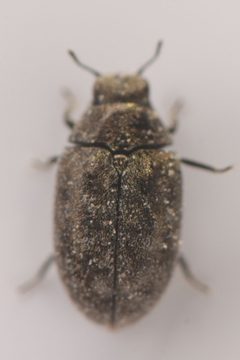
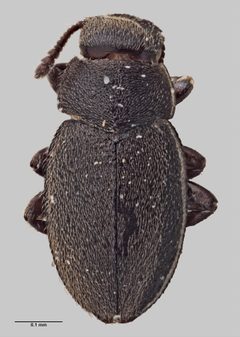
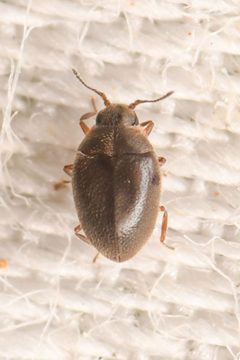
Small beetles, typically less than 5 mm in length. Body form varies by : Limnichinae generally have compact, convex bodies; Hyphalinae (intertidal ) have broadly ovate bodies resembling Byrrhidae more than typical limnichids; Thaumastodinae exhibit diverse morphologies including flightless forms with transverse and widely separated . short to moderately long, often with weakly clubbed tips. typically complete, covering . with variable segmentation.
Habitat
Ecologically heterogeneous. Many associated with water-adjacent : riparian zones, stream margins, coastal areas, and intertidal zones (especially Hyphalinae). Some species fully terrestrial in leaf litter or arboreal habitats. The Austramastodus represents the only known terrestrial Thaumastodinae not associated with permanent aquatic habitats. Hyphalus species specifically inhabit intertidal pools on reefs.
Distribution
Worldwide distribution with greatest diversity in tropical regions. Documented from all major biogeographic regions including: Oriental (Southeast Asia, Taiwan, Philippines, Indonesia, India), Palearctic (including Egypt), Australian (continental Australia, New Zealand), Nearctic (North America), Neotropical, and Afrotropical (Seychelles) regions. Specific records include Vietnam, Laos, Borneo, Papua New Guinea, Bali, Palau, Xisha Islands (China), Cape Range Peninsula (Western Australia), and Myanmar (fossil).
Diet
with documented feeding habits consume moss or . Specific dietary information unavailable for majority of species.
Life Cycle
Larvae of at least one intertidal , Hyphalus insularis, have been observed to be more active in seawater—exceptional among beetles and insects generally. Complete with , larval, pupal, and stages. Detailed information lacking for most species.
Behavior
Hyphalinae inhabit intertidal zones, with larvae exhibiting unusual seawater . Some Thaumastodinae are flightless (). Many species associated with moist microhabitats near water sources. of majority of species undocumented.
Ecological Role
Likely contribute to decomposition and nutrient cycling in moist through feeding on and moss. Intertidal occupy unique marine-freshwater interface . Specific ecosystem functions poorly documented.
Human Relevance
No documented economic importance. Of interest to entomologists studying diversification into aquatic and intertidal . Some serve as indicators for conservation of riparian and coastal .
Similar Taxa
- ByrrhidaeHyphalinae of resembles Byrrhidae in body shape; distinguished by (intertidal vs. terrestrial/mossy) and detailed morphological features
- DryopidaeSimilar aquatic/riparian preferences; separated by tarsal formula and prosternal process structure
- ElmidaeOverlap in riparian ; distinguished by and larval morphological characters including tarsal segmentation
More Details
Fossil Record
The oldest confirmed limnichid fossils are from mid-Cretaceous Burmese amber (~99 Ma), including Burmochares groehni ( Limnichinae, tribe Limnichini). Eocene Baltic amber contains Hernandochares (formerly Platypelochares electricus).
Taxonomic Structure
contains at least three : Limnichinae (majority of ), Hyphalinae ( Hyphalus, 9+ species, intertidal), and Thaumastodinae (primarily Oriental and Australian, includes flightless and terrestrial forms).
Sources and further reading
- BugGuide
- Wikipedia
- GBIF taxonomy match
- iNaturalist taxon
- NCBI Taxonomy
- Catalogue of Life
- A new flightless genus of Thaumastodinae from Australia (Coleoptera: Limnichidae)
- Hyphalus shiyuensis sp. nov. from Xisha Islands, China (Coleoptera, Limnichidae, Hyphalinae)
- Review of the Asian Thaumastodinae (Coleoptera, Byrrhoidea, Limnichidae), with a phylogeny of the genera
- Three new species of the genus Caccothryptus Sharp, 1902 from Asia (Coleoptera: Limnichidae)
- A Distributional Checklist of North American Genera of Aquatic Dryopoid and Dascilloid Beetles (Elmidae, Dryopidae, Limnichidae, Chelonariidae, Heteroceridae, Psephenidae, Ptilodactylidae, Cyphonidae, Georyssidae)
- An annotated checklist of the aquatic Polyphaga (Coleoptera) of Egypt III. Families: Helophoridae, Georissidae, Hydrochidae, Spercheidae, Scirtidae, Elmidae, Dryopidae, Limnichidae and Heteroceridae
- New Genus and Species of Limnichines from the Cretaceous Amber of Myanmar and Taxonomic Notes on the Family Limnichidae (Coleoptera, Polyphaga)
- Lutrochus arizonicusNew Species, with Notes on Ecology and Behavior (Coleoptera, Dryopoidea, Limnichidae)
- Two new species of Byrrhinus Motschulsky, 1858 (Coleoptera, Limnichidae, Limnichinae) from Negros, Philippines.