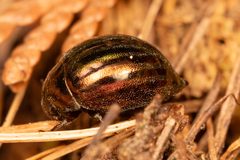
Eusomalia

Eusomalia

Classification

Pronunciation

How to pronounce Eusomalia: /juːsoʊˈmeɪliə/

These audio files are automatically generated. While they are not always 100% accurate, they are a good starting point.

Summary

Eusomalia is a genus of pill beetles, with one described species, E. lecontei, found primarily in northwestern North America. They are characterized by their rounded bodies, which provide them with defense mechanisms against predators.

Physical Characteristics

Eusomalia beetles are characterized by their pill-like shape, which allows them to roll into a ball as a defensive mechanism.

Identification Tips

Look for the rounded body shape typical of pill beetles, along with the specific coloration and markings of E. lecontei.

Habitat

Typically found in moist environments, often under decaying wood or leaf litter.

Distribution

Primarily distributed in the northwestern region of North America.

Diet

The larvae and adults likely feed on decaying plant material.

Life Cycle

Information on the specific life cycle of Eusomalia is limited but is likely to include egg, larval, pupal, and adult stages.

Reproduction

Specific reproductive behavior details of Eusomalia are not widely documented.

Predators

Natural predators include various insectivorous species that inhabit the same environments, like birds and certain beetles.

Conservation Status

Not assessed.

Ecosystem Role

As detritivores, they play a role in the decomposition of plant material.

Collecting Methods

  • Hand collection from leaf litter
  • Soil sampling under decaying logs

Preservation Methods

  • Ethanol preservation
  • Drying and pinning

Evolution

Part of the Byrrhidae family, which has a long evolutionary history with specialized adaptations for moisture retention.

Similar Taxa

Misconceptions

Eusomalia beetles are sometimes confused with true pillbugs, but they are insects and not crustaceans.

Tags

  • beetle
  • Eusomalia
  • Byrrhidae
  • North America
  • entomology