
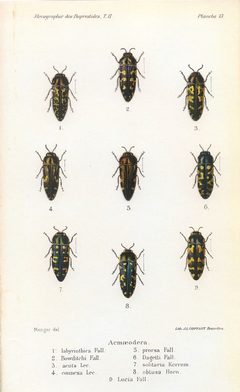
Acmaeodera acuta
LeConte, 1860
Acmaeodera acuta is a metallic wood-boring beetle in the Buprestidae, native to the western United States and Mexico. The shows strong association with riparian , where larvae likely develop in willows (Salix) and feed on a range of plants including willows, roses, and various herbaceous species. It is frequently misidentified in collections due to its similarity to the closely related A. retifera.
Pronunciation
How to pronounce Acmaeodera acuta: /ækmiːoʊˈdɛrə əˈkjuːtə/
These audio files are automatically generated. While they are not always 100% accurate, they are a good starting point.
Identification
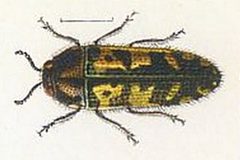
Often confused with Acmaeodera retifera in collections; distinguishing features between these require careful examination. As a member of Acmaeodera, exhibits the characteristic elongate, cylindrical body form typical of the rather than the flattened, compact shape seen in derived buprestid lineages.
Images
Habitat
Fairly restricted to riparian , typically associated with streamside vegetation and moist environments in arid and semi-arid regions of the western United States and Mexico.
Distribution
Western United States and Mexico. GBIF records indicate presence in the , specifically Middle America and North America.
Diet
feed on flowers of Achillea, Encelia, Rosa, Salix, and Sphaeralcea. Larval likely Salix (willows), though this association is inferred from field observations rather than confirmed rearing records.
Host Associations
- Salix - larvalHostlikely
- Achillea - adultHost
- Encelia - adultHost
- Rosa - adultHost
- Salix - adultHost
- Sphaeralcea - adultHost
Similar Taxa
- Acmaeodera retiferafrequently confused with A. acuta in collections; close morphological similarity requires careful examination to distinguish
More Details
Collection identification challenges
The ' frequent misidentification with A. retifera highlights the need for careful morphological examination when working with museum specimens and field collections of western North American Acmaeodera.