
Chrysobothris bispinosa
Schaeffer, 1909
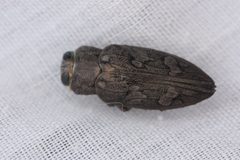
Chrysobothris bispinosa is a of metallic wood-boring beetle in the Buprestidae, first described by Schaeffer in 1909. It belongs to the large Chrysobothris, which contains numerous species that are often difficult to distinguish from one another. The species is known from both Central America and North America. Like other members of its genus, it is presumed to develop in dead or dying wood, though specific details about its remain poorly documented.
Pronunciation
How to pronounce Chrysobothris bispinosa: /ˌkrɪsoʊˈbɒθrɪs baɪˌspaɪˈnoʊsə/
These audio files are automatically generated. While they are not always 100% accurate, they are a good starting point.
Identification
Specific diagnostic characters for distinguishing C. bispinosa from other Chrysobothris are not documented in the available sources. The Chrysobothris as a whole is taxonomically challenging, with species often requiring examination of subtle morphological features such as elytral , antennal structure, and pygidial form for accurate identification.
Images
Distribution
Recorded from Central America and North America. Distribution records indicate presence in both Middle America and North America, though specific countries or regions within these broad areas are not detailed in available sources.
Similar Taxa
- Chrysobothris femorata species-groupMembers of this -group are among the most commonly encountered and taxonomically challenging Chrysobothris in North America, and C. bispinosa may be confused with them without careful examination. The C. femorata group was revised by Wellso and Manley (2007), but C. bispinosa is not included in that revision.
More Details
Taxonomic context
Chrysobothris bispinosa was described by Schaeffer in 1909, making it one of the earlier described in this large . The genus Chrysobothris currently contains over 100 described species in North America alone, many of which remain poorly known biologically.
Data limitations
This is represented by only 2 observations on iNaturalist as of the data retrieval date, suggesting it is rarely encountered or underreported. No plant records, detailed distribution data, or biological studies were found in the available sources.
Sources and further reading
- BugGuide
- Wikipedia
- GBIF taxonomy match
- iNaturalist taxon
- Catalogue of Life
- Let’s make a deal! | Beetles In The Bush
- Introducing Chrysobothris caddo | Beetles In The Bush
- The perfectly polyphagous Chrysobothris purpureovittata | Beetles In The Bush
- Chrysobothris orono in Tennessee | Beetles In The Bush
- Chrysobothris viridiceps | Beetles In The Bush
- The lesser of two jewels | Beetles In The Bush