
Buprestis sulcicollis
(LeConte, 1860)
Wrinkled-neck Buprestid Beetle
Buprestis sulcicollis is a metallic wood-boring beetle in the Buprestidae. measure 11–15.5 mm. The is found in North America, primarily in the eastern and central regions from the Great Lakes to the Atlantic seaboard, with records extending west to Alberta and the Northwest Territories. Larval are pitch pine (Pinus rigida) and eastern white pine (Pinus strobus). The species was first recorded for Massachusetts in 2009.
Pronunciation
How to pronounce Buprestis sulcicollis: /buˈprɛstɪs sʌlsɪˈkɒlɪs/
These audio files are automatically generated. While they are not always 100% accurate, they are a good starting point.
Identification
Distinguished from the similar Buprestis striata by subtle morphological differences; expert examination is required for reliable identification. The violet sheen and less brilliant metallic coloration compared to other Buprestis provides a field clue. The pronotal are a diagnostic feature referenced in the species epithet.
Images
Appearance
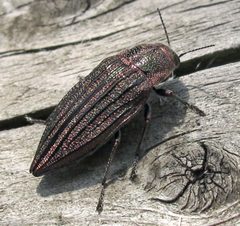
are 11–15.5 mm in length. The has a , violet-metallic appearance that reflects light with a geode-like quality. The pronotum shows distinct (grooves), giving the its name 'sulcicollis' (wrinkled neck). Overall coloration is less brilliant than many , appearing relatively non-descript in the field until examined closely.
Habitat
Associated with pine forests, particularly areas with pitch pine and eastern white pine. have been observed in forest clearings and near logging residue. The appears to favor where pines occur, including bluff tops with Virginia pine in the southeastern United States.
Distribution
North America: primarily from the Great Lakes region to the Atlantic seaboard. Records extend west to Alberta and the Northwest Territories in Canada. First documented occurrence in Massachusetts recorded in 2009.
Diet
Larvae develop in pitch pine and eastern white pine. feeding habits are not documented.
Host Associations
- Pinus rigida - larval pitch pine
- Pinus strobus - larval eastern white pine
Behavior
are highly active. Like other Buprestis , they are relatively clumsy and easy to capture compared to the faster-moving Chrysobothris.
Ecological Role
Larval development in pine trees contributes to wood decomposition processes in forest .
Similar Taxa
- Buprestis striataSimilar appearance requiring expert examination to distinguish; both occur in eastern North American pine
More Details
Taxonomic history
A 2009 Massachusetts specimen was initially identified as Buprestis striata by the collector before being corrected to B. sulcicollis by BugGuide experts, representing a new state record.