
Trachys minutus
(Linnaeus, 1758)
elm leaf miner
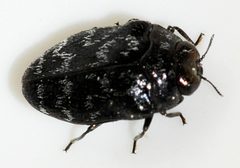
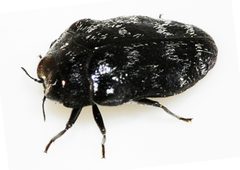
Trachys minutus is a small jewel beetle (Buprestidae) measuring 3–3.5 mm in length. It is native to Europe and the eastern Palearctic region and has been introduced to North America, where it is established in Massachusetts. The is notable for its leaf-mining larvae, which feed on the mesophyll of elm leaves. Females oviposit directly on leaf surfaces, and the resulting larvae create characteristic blotch mines. Two are recognized: T. m. minutus and T. m. salicis.
Pronunciation
How to pronounce Trachys minutus: /ˈtrækɪs mɪˈnjuːtəs/
These audio files are automatically generated. While they are not always 100% accurate, they are a good starting point.
Identification
Distinguished from similar small buprestids by its association with elm leaf mines and its minute size (3–3.5 mm). The leaf-mining habit of the larvae is diagnostic for the Trachys within Buprestidae. In North America, it can be distinguished from native Trachys by its documented association with Ulmus and its introduced status in the northeastern United States.
Images
Appearance
Small , 3–3.5 mm in length. Body dark colored, shiny, and slightly hairy. Overall compact form typical of the .
Habitat
Associated with deciduous trees, particularly elm (Ulmus). Larval is the interior of leaves, where mining occurs between the epidermal layers. habitat includes the foliage and trunks of trees.
Distribution
Native to most of Europe, the eastern , and the Near East. Introduced and established in North America, specifically recorded from Massachusetts, U.S.A.
Diet
Larvae feed on the green tissue (mesophyll) between the upper and lower of elm leaves, creating blotch mines. diet is not documented in available sources.
Host Associations
- Ulmus - primary ; female oviposits on leaves, larvae mine within leaf tissue
- Salix - implied by name salicis, but specific documentation not provided in sources
Life Cycle
Females lay on the upper surface of leaves. Larvae hatch and feed as leaf miners, creating cavities (mines) within the leaf parenchyma. likely occurs within the leaf or in soil, though specific details are not documented in available sources.
Behavior
Females oviposit on leaf surfaces of trees. Larvae are endophagous leaf miners. are presumably active on foliage.
Ecological Role
As a , larvae function as herbivores that reduce photosynthetic capacity of leaves. The is an introduced in North America, where its ecological impacts have not been quantified.
Human Relevance
Introduced to North America (Massachusetts) as an , presumably via international plant trade. Not known to cause significant economic damage, though leaf mining can reduce aesthetic value of ornamental elms. Documented in the entomological literature as a newly established exotic species in 2012.
Similar Taxa
- Native North American Trachys speciesSimilar size and , but T. minutus distinguished by introduced status in northeastern North America and documented association with Ulmus
- Other Buprestidae leaf minersFew Buprestidae exhibit leaf-mining habits; this trait helps distinguish Trachys from most other in the
More Details
Subspecies
Two recognized: Trachys minutus minutus (Linnaeus, 1758) and Trachys minutus salicis (Lewis, 1893). The latter name suggests association with Salix (willow), though specific documentation is not provided in available sources.
Introduction to North America
First documented in Massachusetts, U.S.A. by Westcott & Murray (2012), who reported its apparent establishment. This represents a transatlantic introduction from the native European range.