
Agrilus hyperici
(Creutzer, 1799)
St. John's wort root borer
Agrilus hyperici is a jewel beetle ( Buprestidae) used as a agent against the weed Hypericum perforatum (common St. John's wort). Native to Europe, it was first introduced to the United States in 1950 and is now established in the northwestern United States and Australia. The is notable for its root-boring larval stage that typically kills plants.
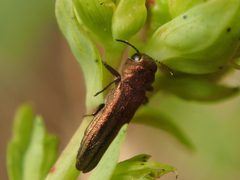
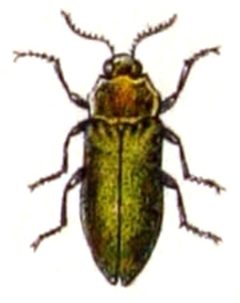
Pronunciation
How to pronounce Agrilus hyperici: //ˈæɡrɪləs ˌhaɪˈpɛrɪkaɪ//
These audio files are automatically generated. While they are not always 100% accurate, they are a good starting point.
Images
Habitat
Associated with stands of Hypericum perforatum; established in mountainous areas of the northwestern United States and in Australia.
Distribution
Native to Europe; introduced and established in the northwestern United States (especially mountainous areas) and Australia.
Seasonality
active in July and August; females deposit during this period.
Diet
Larvae feed on root tissue of Hypericum perforatum for approximately one year; has been observed to attack Hypericum concinnum (goldwire) in California but without destructive impact.
Host Associations
- Hypericum perforatum - larval primary ; root tissue consumed
- Hypericum concinnum - larval attacked in California but without significant impact
Life Cycle
Females deposit low on plant stems in July and August. Larvae emerge and migrate to roots, where they feed for approximately one year. occurs within root remnants. Few plants survive attack.
Ecological Role
agent for Hypericum perforatum; larval feeding typically results in plant death.
Human Relevance
Intentionally introduced to the United States in 1950 for biocontrol of St. John's wort, a noxious weed and .
Sources and further reading
- BugGuide
- Wikipedia
- GBIF taxonomy match
- iNaturalist taxon
- NCBI Taxonomy
- Catalogue of Life
- Two new species of Agrilus from Mexico | Beetles In The Bush
- Agrilus fuscipennis on Persimmon | Beetles In The Bush
- GBCT Beetle #2: Agrilus walsinghami | Beetles In The Bush
- North America’s Most Beautiful Agrilus Jewel Beetle | Beetles In The Bush
- A flower visiting jewel beetle that is not an Acmaeodera | Beetles In The Bush
- Josef Knull was wrong! | Beetles In The Bush
- Population Trends, Seasonal Phenology, and Impact of Chrysolina quadrigemina, C. hyperici (Coleoptera: Chrysomelidae), and Agrilus hyperici (Coleoptera: Buprestidae) Associated with Hypericum perforatum in Northern Idaho