
Agrilus cephalicus
LeConte, 1860
dogwood agrilus, dogwood cambium borer
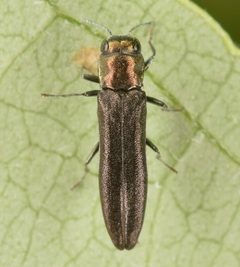
Agrilus cephalicus, commonly known as the dogwood agrilus or dogwood cambium borer, is a metallic wood-boring beetle in the Buprestidae. The is found in North America and is associated with dogwood trees (Cornus spp.) as its larval . are metallic wood-boring beetles typical of the Agrilus. The specific epithet "cephalicus" refers to -like characteristics, though the precise morphological basis for this name is not detailed in available sources.


Pronunciation
How to pronounce Agrilus cephalicus: //ˈæɡrɪləs sɛˈfælɪkəs//
These audio files are automatically generated. While they are not always 100% accurate, they are a good starting point.
Identification
Agrilus cephalicus can be distinguished from other Agrilus by its association with dogwood (Cornus) . The species name "cephalicus" suggests -related morphological features that may aid in identification, though specific diagnostic characters are not well-documented in the provided sources. As with many Agrilus species, identification often requires examination of genitalia and comparison with . The species is one of many similar-sized, metallic buprestids in eastern North America, making host plant association a critical clue for field identification.
Images
Habitat
Associated with dogwood trees (Cornus spp.), particularly flowering dogwood (Cornus florida). The inhabits deciduous forests and woodland edges where dogwood occurs. Larval development occurs within the cambium of living dogwood trees.
Distribution
North America. Distribution records indicate presence in Canada (Alberta, British Columbia) and the United States. The is part of the Nearctic fauna.
Diet
Larvae feed in the cambium of living dogwood trees (Cornus spp.), making this a cambium-boring rather than a typical wood-boring species that attacks dead or dying wood. feeding habits are not documented in the provided sources.
Host Associations
- Cornus - larval Dogwood trees; larvae develop in cambium of living trees
- Cornus florida - larval Flowering dogwood; specific association documented
Life Cycle
Typical of Agrilus : laid on bark of trees, larvae tunnel in cambium creating galleries, occurs in pupal chambers within the wood, emerge through D-shaped exit holes. The cambium-feeding habit distinguishes this species from many Agrilus that attack dead or dying wood.
Ecological Role
As a cambium borer in living dogwood trees, this acts as a primary stressor or secondary invader that may contribute to tree decline. The species is not considered a major forest pest but may impact ornamental dogwoods.
Human Relevance
Minor pest of ornamental dogwood trees. The "dogwood cambium borer" reflects its potential economic significance in horticultural settings. Not a significant timber pest.
Similar Taxa
- Other Agrilus speciesMany Agrilus are similar in size, coloration, and general ; association with dogwood is the primary distinguishing feature for A. cephalicus
- Agrilus muticusAnother North American Agrilus with documented flower-visiting and specific associations; A. muticus is associated with winecup (Callirhoe involucrata) rather than woody hosts
More Details
Etymology
The specific epithet "cephalicus" is derived from Greek "kephale" meaning , likely referring to some head-like morphological feature of the , though the precise characteristic is not documented in available sources.
Taxonomic history
Described by John Lawrence LeConte in 1860, a prolific 19th-century American entomologist who described numerous North American beetles. The has remained in the Agrilus since description.
Observation data
iNaturalist records 13 observations of this , indicating it is infrequently encountered or underreported, consistent with its specialized association and cryptic larval habits.