
Hadrobregmus
C.G. Thomson, 1859
Species Guides
3- Hadrobregmus alternatus(death-watch beetle)
- Hadrobregmus notatus(Marked Death-watch Beetle)
- Hadrobregmus quadrulus
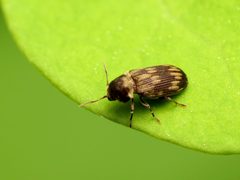
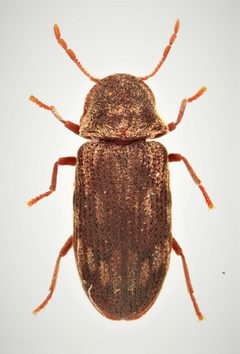
Pronunciation
How to pronounce Hadrobregmus: /hædˈroʊbreɪɡməs/
These audio files are automatically generated. While they are not always 100% accurate, they are a good starting point.
Identification
Distinguished from related Ptinidae (e.g., Anobium, Xestobium) by the form of the pronotum and antennal structure. Hadrobregmus often show more pronounced elytral markings than Anobium. Confirmation requires examination of male genitalia and detailed antennal club structure. The genus was historically confused with Anobium, and accurate identification relies on modern taxonomic revisions.
Images
Habitat
Associated with dead, decaying hardwood and softwood. Larvae develop in moist, rotting wood, particularly in forested environments and woodlands. are found on or near larval material.
Distribution
Northern Hemisphere distribution including Europe (Scandinavia, Central Europe, Mediterranean region), North America (United States, particularly northeastern states including Vermont), and potentially Asia. Records confirmed from Denmark, Norway, Sweden, and the United States.
Seasonality
activity period varies by and latitude. In temperate regions, adults have been observed from spring through late summer. Specific periods are poorly documented for most species.
Diet
Larvae feed on wood, consuming cellulose and associated fungal decay. The diet includes both hardwoods and softwoods in various stages of decomposition.
Host Associations
- dead and decaying wood - larval food sourcevarious hardwood and softwood
- wood-decay fungi - associated with larval nutritionfungal decay may be necessary for larval development
Life Cycle
Complete with , larva, pupa, and stages. Larvae are wood-borers, creating galleries in decaying timber. Development duration varies with wood condition and temperature. occurs within the wood. Adults emerge through exit holes and may be short-lived, focusing on .
Behavior
Larvae are cryptic, feeding internally within wood. are generally secretive, often remaining near sites. Limited information on adult ; likely poor fliers typical of the .
Ecological Role
Decomposers that contribute to wood breakdown and nutrient cycling in forest . By consuming decaying wood, they facilitate the return of nutrients to soil systems and create for other .
Human Relevance
Similar Taxa
- AnobiumHistorically confused with Hadrobregmus; differs in pronotum shape and antennal club structure
- XestobiumSimilar wood-boring habit and appearance; Xestobium rufovillosum (deathwatch beetle) is a major pest, distinguished by different elytral and preferences
- ErnobiusRelated Ptinidae with similar ; separation requires detailed examination of antennal and genitalic characters
Misconceptions
The has been variously placed in Anobiidae or Ptinidae depending on classification system used; this reflects ongoing taxonomic debate rather than biological uncertainty. Some literature may treat Hadrobregmus as synonymous with or subordinate to Anobium, but modern treatments maintain it as distinct.
More Details
Taxonomic history
The -level placement of Hadrobregmus has been unstable. GBIF lists Anobiidae, while iNaturalist and NCBI recognize Ptinidae. This follows the elevation of Ptininae to family rank in recent classifications. The was revised by Thomson in 1859 to separate certain from Anobium.
Species diversity
Approximately ten are recognized, with H. pertinax (Linnaeus, 1758) being one of the earliest described. The appears to be most diverse in Europe, with several species to restricted regions (e.g., H. carpetanus in the Iberian Peninsula).