
Dermestes reductus
Kalík, 1952
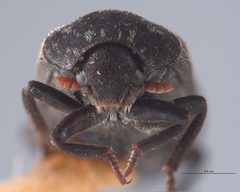
Dermestes reductus is a small dermestid native to North America, closely resembling the more common larder beetle (Dermestes lardarius) but distinguished by morphological differences in size, coloration, and genitalia. Unlike its relative, D. reductus is exclusively found in natural wooded , typically under tree bark, and has no known association with human dwellings. It belongs to the 'lardarius' group within the Dermestes.


Pronunciation
How to pronounce Dermestes reductus: //dɛrˈmɛstɛs rɛˈdʌktʊs//
These audio files are automatically generated. While they are not always 100% accurate, they are a good starting point.
Identification
Most reliably distinguished from Dermestes lardarius by: (1) smaller size (6–6.5 mm vs. 7–8.5 mm, though D. lardarius size ranges overlap); (2) grey rather than yellowish-brown hairs on the elytral patch; (3) entirely black to the patch (fresh specimens); (4) more parallel elytral sides and flatter body profile; (5) less raised prothoracic margins; and (6) male genitalia shape ( constricted medially). Ecological context provides additional separation: D. reductus occurs exclusively in natural wooded settings, never in buildings.
Images
Habitat
Wooded areas, specifically under tree bark. Occupies natural forest environments without association with human-modified structures.
Distribution
North America. Documented from Canadian provinces: Alberta, British Columbia, and Ontario. Distribution likely broader across forested regions of North America but precise range limits require further documentation.
Human Relevance
None known. Unlike Dermestes lardarius, which is a stored product pest and nuisance in human dwellings, D. reductus has no documented association with human activities or structures. Not reported as a pest of stored products, taxidermy, or domestic environments.
Similar Taxa
- Dermestes lardariusExtremely similar external appearance; distinguished by size, elytral hair color (yellowish-brown vs. grey), body shape, and male genitalia . D. lardarius is and found in buildings, while D. reductus is restricted to natural wooded .
- Dermestes signatusMember of the same 'lardarius' group in North America; specific distinguishing characters require detailed examination.
- Dermestes voraxAsian member of the 'lardarius' group; not sympatric but shares morphological similarities.
More Details
Species group affinities
Dermestes reductus belongs to the 'lardarius' group, which includes D. lardarius (), D. signatus (North America), and D. vorax (Asia). This grouping reflects close phylogenetic relationships and morphological similarities that require careful diagnostic examination.
Ecological divergence
The strict separation between D. reductus (natural woodlands) and D. lardarius (, buildings) represents a significant ecological divergence within the group, likely reflecting different evolutionary pressures and resource utilization strategies.