
Attagenus fasciatus
Thunberg, 1795
Banded Black Carpet Beetle, Tobacco Seed Beetle, Wardrobe Beetle
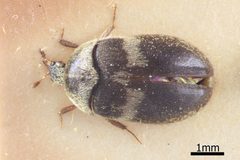
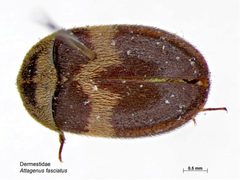
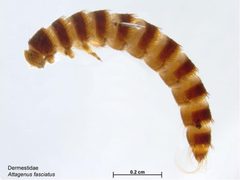
Attagenus fasciatus is a carpet beetle in the Dermestidae, commonly known as the banded black carpet beetle, tobacco , or wardrobe . It occurs in North America, Oceania, Europe, and tropical and subtropical regions worldwide. The is a significant pest of stored products, textiles, and animal materials, with larvae feeding on keratin-containing substrates.
Pronunciation
How to pronounce Attagenus fasciatus: //ˌætəˈdʒiːnəs ˌfæsiˈeɪtəs//
These audio files are automatically generated. While they are not always 100% accurate, they are a good starting point.
Images
Habitat
Indoor environments associated with stored products, textiles, and animal-derived materials; also found in warehouses and insectariums where it can invade and proliferate
Distribution
North America, Oceania, Europe; widespread throughout tropical and subtropical regions worldwide; nearly
Diet
Keratin-containing materials including dried pupae and , feathers, fur, wool, and wheat feed; larvae feed on animal-origin substrates
Life Cycle
incubation: 12-16 days; 10-12 larval instars; total larval period 243-329 days depending on diet and conditions; total life-cycle 267-355 days; development highly temperature and humidity dependent, ranging from 26.5 days at optimal conditions (30°C, 75% RH) to 109.6 days at 20°C and 40% RH
Behavior
survive 4-7 days without food; larvae more cold-tolerant than adults, surviving -15°C for 7 days; adults survive 5 days at 45°C; development fails at 35°C and above; pupae show intermediate temperature
Ecological Role
Scavenger on animal materials; stored-product pest causing damage to grains, textiles, and animal products
Human Relevance
Economic pest of stored grain, wool, fur, feathers, and textiles; known to invade insectariums and collections; females lay 22-73 depending on environmental conditions
More Details
Temperature and Humidity Requirements
Optimal development occurs at 25-30°C with 75-85% relative humidity. Temperature extremes significantly affect survival, development rate, and .
Invasion Risk
Documented to cause massive invasions in insectariums, particularly those housing Triatominae colonies, where it can outcompete or disrupt research colonies.
Sources and further reading
- BugGuide
- Wikipedia
- GBIF taxonomy match
- iNaturalist taxon
- New Analysis Refines Taxonomy of Dermestid Beetles
- What do insects do in winter? Migrants in the DMV: Common Buckeye, Junonia coenia, Variegated Fritillary, Euptoieta Claudia, Painted Lady, Vanessa cardui, Large Milkweed bug, Oncopeltus fasciatus — Bug of the Week
- Bugs in Orange and Black II: Large milkweed bug, Oncopeltus fasciatus — Bug of the Week
- Orange and Black II: Milkweed leaf beetle, Labidomera clivicollis; Oleander aphid, Aphis nerii; Milkweed Bug, Oncopeltus fasciatus; Monarch, Danaus plexippus — Bug of the Week
- Bugs in orange and black - Monarch butterfly, Danaus plexippus Milkweed Bug - Oncopeltus fasciatus; Milkweed tiger moth, Euchaetes egle — Bug of the Week
- Orange and Black Bugs- Milkweed leaf beetle, Labidomera clivicollis; Oleander aphid, Aphis nerii; Milkweed Bug - Oncopeltus fasciatus; Monarch butterfly, Danaus plexippus — Bug of the Week
- Effect of temperature and humidity on the biology of Attagenus fasciatus (Thunberg) (Coleoptera: Dermestidae)
- Biology of Attagenus fasciatus Thunberg (Coleoptera: Dermestidae) on four different diets of animal origin
- Effect of temperature extremes on the survival and biology of the carpet beetle, Attagenus fasciatus (Thunberg) (Coleoptera: Dermestidae)
- Massive invasion on a Triatominae insectarium (Hemiptera: Heteroptera: Reduviidae) by Attagenus fasciatus (Thunberg, 1795) (Coleoptera: Dermestidae: Attageninae).