
Anthrenus castaneae
Melsheimer, 1844
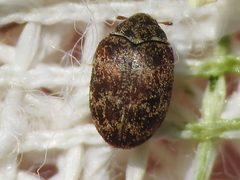
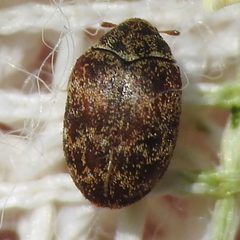
Anthrenus castaneae is a carpet beetle in the Dermestidae. First described by Melsheimer in 1844, it is native to North America with records from Canada and the United States. The species was historically placed in the subgenus Florilinus. Larval specimens have been documented in association with spider sacs and retreats, representing a distinctive relationship among carpet beetles.
Pronunciation
How to pronounce Anthrenus castaneae: //ˈæn.θɹə.nəs kæˈstæ.ni.eɪ//
These audio files are automatically generated. While they are not always 100% accurate, they are a good starting point.
Images
Habitat
Spider sacs and retreats
Distribution
North America; recorded from Canada (New Brunswick, Nova Scotia, Ontario) and the United States
Host Associations
- spider egg sacs - larval Larvae discovered inhabiting spider sacs
- spider retreats - larval Larvae documented in spider retreats
Behavior
Larvae inhabit spider sacs and retreats
Similar Taxa
- Anthrenus verbasciSimilar patterned ; A. verbasci is and frequently encountered in human dwellings, while A. castaneae has more restricted distribution and documented association with spider
- Anthrenus scrophulariaeAnother North American carpet beetle ; similarly found on flowers, but A. castaneae distinguished by documented larval in spider sacs
- Anthrenus museorum carpet beetle ; A. castaneae distinguished by native North American distribution and specific association with spider
More Details
Taxonomic placement
The has been treated as Anthrenus (Florilinus) castaneae, indicating historical placement in the subgenus Florilinus within Anthrenus
Research significance
The 2024 discovery of larvae associated with spider sacs and retreats documents a novel association for this , expanding understanding of dermestid
Sources and further reading
- BugGuide
- Wikipedia
- GBIF taxonomy match
- iNaturalist taxon
- Bug Eric: Carpet Beetles, Genus Anthrenus
- Hide and hair, Carpet beetles, Anthrenus sp. — Bug of the Week
- When the American Chestnut Vanished, What Happened to Insects That Fed On It?
- ID Challenge #9 | Beetles In The Bush
- New Analysis Refines Taxonomy of Dermestid Beetles
- Bug Eric: November 2014
- Discovery of the Larvae of Anthrenus (florilinus) castaneae Melsheimer 1844 (Coleoptera: Dermestidae) Associated with Spider Egg Sacs and Retreats