
Polycaon stoutii
(LeConte, 1853)
Stout's branch borer, black polycaon, Stout's Hardwood Borer
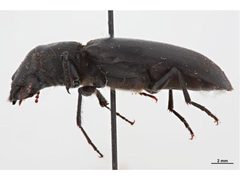
Polycaon stoutii is a woodboring in the Bostrichidae. are cylindrical, hairy, and black, measuring 10-23 mm. The is native to western North America but has been introduced to other regions through wood commerce. It is known for exceptionally long larval development periods and occasional from finished wood products.
Pronunciation
How to pronounce Polycaon stoutii: //ˌpɒlɪˈkeɪən ˈstaʊti.aɪ//
These audio files are automatically generated. While they are not always 100% accurate, they are a good starting point.
Identification
Distinguished from Polycaon granulatus by having 11 antennal segments (versus fewer) and cylindrical 2nd and 3rd tarsal segments. Distinguished from Polycaon punctatus by its black coloration (P. punctatus is not uniformly black) and by the 3rd antennal segment being much shorter than the 4th.
Images
Habitat
Develops within hardwood trees and wood products. Breeds in dead or dying hardwoods, though has been reported in healthy trees. occurs in standing timber, recently harvested logs, and processed lumber.
Distribution
Native to western North America: British Columbia, Pacific Coast states (Washington, Oregon, California), and Arizona. Introduced to Europe, Central America, and elsewhere through wood shipping. GBIF records indicate presence in Europe & Northern Asia (excluding China) and Middle America.
Diet
Larvae feed on hardwood xylem. do not feed on wood; their diet is not documented.
Host Associations
- Sequoia sempervirens - larval redwood
- Quercus agrifolia - larval coast live oak
- Acer - larval maple
- Arctostaphylos - larval manzanita
- Arbutus - larval madrone
- Umbellularia californica - larval California laurel
- Platanus - larval sycamore
- Carya - larval hickory
- Swietenia - larval mahogany
- Fraxinus - larval ash
- Various fruit trees - larval not specified
Life Cycle
Females bore into wood and deposit in tunnels. Larval development occurs entirely within wood, lasting at minimum one year and documented to exceed twenty years in some individuals. occurs within the wood, with emerging through exit holes.
Behavior
are known to emerge from wooden furniture years after the wood was processed, indicating larvae can survive and complete development in dried, finished lumber. Females initiate gallery construction for oviposition.
Ecological Role
Contributes to decomposition of dead and dying hardwoods. In natural settings, acts as a saproxylic organism in forest .
Human Relevance
Considered a pest of timber and finished wood products due to larval damage and unexpected from furniture. Spread to new regions via international wood commerce.
Similar Taxa
- Polycaon granulatusDiffers in antennal segment count and tarsal segment shape; P. stoutii has 11 antennal segments and cylindrical 2nd-3rd tarsal segments
- Polycaon punctatusDiffers in coloration and antennal proportions; P. stoutii is uniformly black with 3rd antennal segment much shorter than 4th