
Pasimachus strenuus
LeConte, 1874
Pasimachus strenuus is a ground beetle in the Carabidae, described by LeConte in 1874. It belongs to a of large, robust carabids sometimes referred to as 'warrior beetles' due to their formidable appearance. The species occurs in North America, though specific ecological details remain limited in published sources.
Pronunciation
How to pronounce Pasimachus strenuus: //ˌpæsɪˈmeɪkəs ˈstrɛnjuəs//
These audio files are automatically generated. While they are not always 100% accurate, they are a good starting point.
Identification
Distinguished from other Pasimachus by specific morphological features established in LeConte's 1874 description. The specific epithet 'strenuus' (Latin for 'vigorous' or 'active') may allude to behavioral or morphological characteristics. Precise identification requires examination of genitalic structures, elytral striation patterns, and body proportions relative to such as P. elongatus and P. depressus.
Images
Appearance
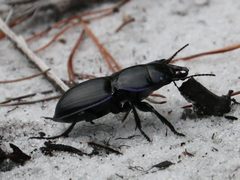
Large, robust ground beetle. As a member of Pasimachus, likely possesses prominent, powerful and a heavily sclerotized body. The is characterized by a somewhat flattened, broad pronotum and long, strong legs adapted for running. Coloration typically dark, often with metallic or iridescent reflections in some .
Distribution
Recorded from the United States; occurs in North America. Specific state or regional records are not detailed in available sources.
Similar Taxa
- Pasimachus elongatusCongeneric sharing large size, robust build, and ground beetle habits; distinguished by specific morphological differences in body proportions and elytral features
- Pasimachus depressusAnother large Pasimachus , sometimes called 'blue-margined ground beetle'; differs in coloration and elytral margin characteristics
More Details
Genus characteristics
Pasimachus are among the largest and most heavily built North American carabids. The has been proposed for the 'warrior beetles' by ground beetle Terry Erwin, referencing their formidable mandibular armament and predatory prowess.
Taxonomic history
Described by John Lawrence LeConte in 1874, a prolific 19th-century American entomologist who named thousands of . The specific epithet 'strenuus' is Latin for 'vigorous,' 'active,' or 'energetic.'