Omophron americanum
Dejean, 1831
American round sand beetle
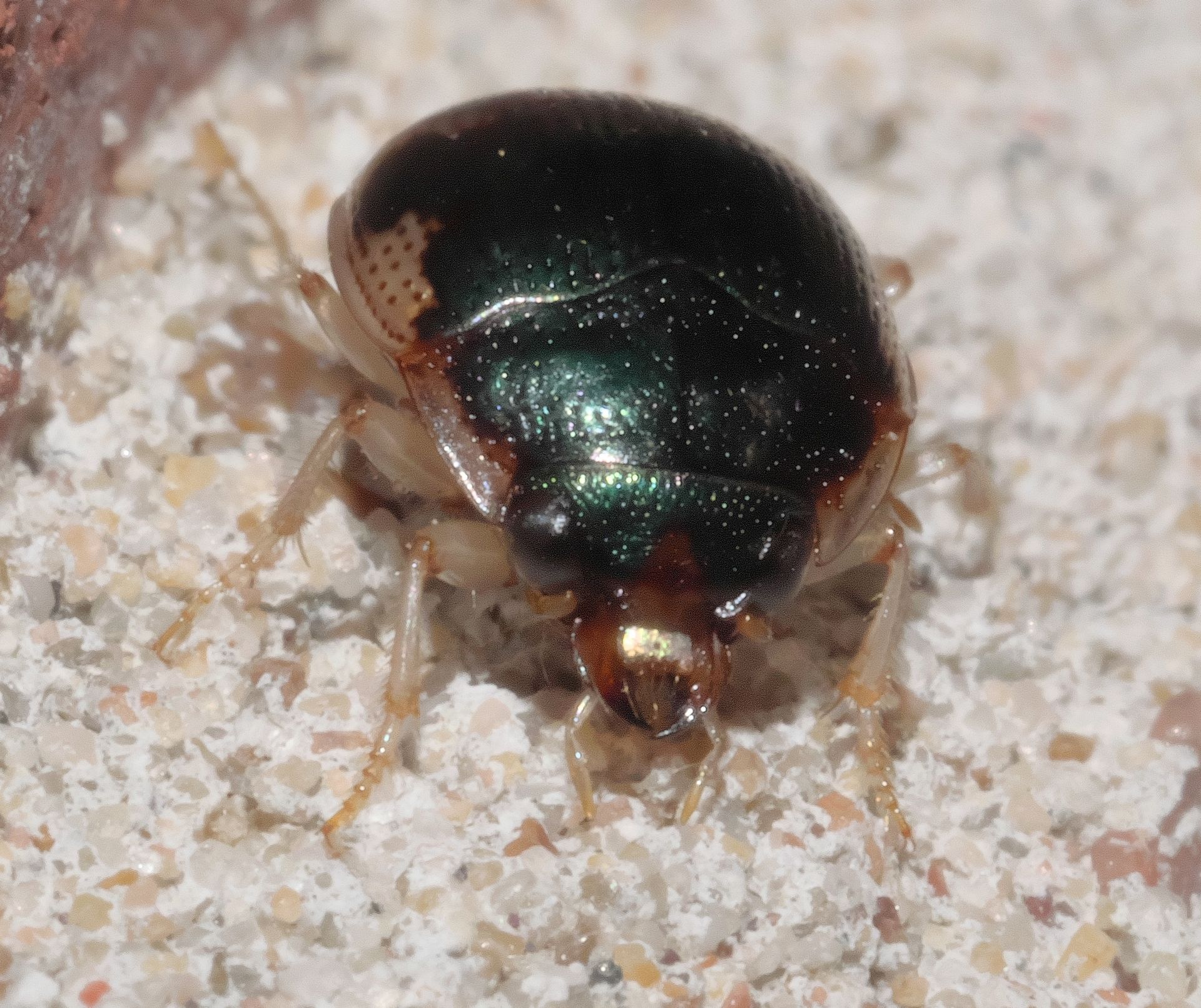
Omophron americanum, commonly known as the American round sand , is a small ground beetle in the Carabidae. It inhabits sandy or clay substrates near standing water across most of the United States and Canada. The exhibits distinctive morphological features including striated and variable color patterning. It has been documented as gregarious and capable of stridulation.
Pronunciation
How to pronounce Omophron americanum: /oʊˈmɒfrɒn əˌmɛrɪˈkeɪnəm/
These audio files are automatically generated. While they are not always 100% accurate, they are a good starting point.
Identification
Distinguished from other Omophron by combination of V-shaped pale marking on , punctuated metasternum, and two setae on mesocoxa. The striated and broad, flattened body form are characteristic of the . Variable reddish-yellow and dark color pattern may aid recognition but requires comparison with sympatric species for reliable identification.
Images
Appearance
Body broad and rather flat, length 5.1–7.0 mm. Coloration reddish-yellow with dark markings on upper surface; variable pattern. Underside darker brown. striated. with V-shaped pale area. Metasternum punctuated. Mesocoxa with two setae.
Habitat
Immediate vicinity of usually standing waters, on bare or sparsely vegetated sandy or clay substrates. Elevation range 260–2,200 m.
Distribution
North America: most of the United States and Canada, except British Columbia.
Seasonality
Copulation April–May. Females gravid May–June. Moulting to stage July–September. Overwinters as .
Life Cycle
copulate in spring (April–May). Females become gravid May–June. Post-embryonic development includes moulting to condition July–September. overwinters in adult stage, completing cycle.
Behavior
Gregarious. Capable of stridulation (sound production).
Similar Taxa
- Other Omophron speciesShare -level characters including broad flattened body form and striated ; require examination of pattern, metasternal punctuation, and mesocoxal setae for separation
More Details
Altitude range
Documented occurrence from 260 m to 2,200 m elevation
Sources and further reading
- BugGuide
- Wikipedia
- GBIF taxonomy match
- iNaturalist taxon
- NCBI Taxonomy
- Get them when they're little - Eastern tent caterpillar, Malacosoma americanum — Bug of the Week
- Hairy wanderers - Eastern tent caterpillars, Malacosoma americanum — Bug of the Week
- Time for tents - Eastern tent caterpillar, Malacosoma americanum — Bug of the Week
- Return of the tent makers - Eastern tent caterpillar, Malacosoma americanum — Bug of the Week
- The silk trail - Eastern tent caterpillar, Malacosoma americanum — Bug of the Week
- Just can't wait: Eastern tent caterpillars, Malacosoma americanum — Bug of the Week