
Tetragonoderus fasciatus
Haldeman, 1843
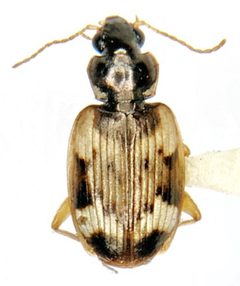
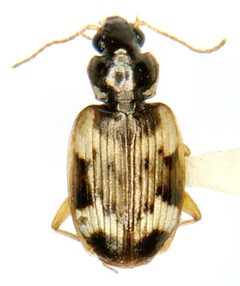
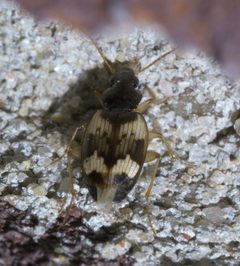
Tetragonoderus fasciatus is a ground beetle in the Carabidae, first described by Haldeman in 1843. It belongs to a of small carabid beetles distributed across North America. The specific epithet 'fasciatus' refers to a banded or striped color pattern. As with most members of Carabidae, it is likely a predatory , though detailed ecological studies for this particular species appear limited in the available literature.
Pronunciation
How to pronounce Tetragonoderus fasciatus: /tɛˌtræɡəˈnoʊdərəs fæsiˈeɪtəs/
These audio files are automatically generated. While they are not always 100% accurate, they are a good starting point.
Identification
Tetragonoderus fasciatus can be distinguished from by its banded (fasciatus) color pattern. The Tetragonoderus comprises small ground beetles that typically exhibit somewhat flattened bodies and relatively short . -level identification within Tetragonoderus generally requires examination of genitalic structures and detailed elyral microsculpture; external color pattern alone may be insufficient for definitive identification without reference to or keys.
Images
Distribution
Recorded from Canada, the United States, and Mexico. GBIF distribution records indicate presence across North America.
Similar Taxa
- Other Tetragonoderus species share similar small size, body shape, and general ground beetle . Distinguishing features include specific color pattern elements and genitalic structures.
More Details
Taxonomic History
Originally described as Coptodera fasciata before transfer to Tetragonoderus.
Data Availability
This has 223 observations on iNaturalist, suggesting it is encountered with moderate frequency, though published ecological and behavioral studies appear sparse.
Sources and further reading
- BugGuide
- Wikipedia
- GBIF taxonomy match
- iNaturalist taxon
- NCBI Taxonomy
- What do insects do in winter? Migrants in the DMV: Common Buckeye, Junonia coenia, Variegated Fritillary, Euptoieta Claudia, Painted Lady, Vanessa cardui, Large Milkweed bug, Oncopeltus fasciatus — Bug of the Week
- Bugs in Orange and Black II: Large milkweed bug, Oncopeltus fasciatus — Bug of the Week
- Orange and Black II: Milkweed leaf beetle, Labidomera clivicollis; Oleander aphid, Aphis nerii; Milkweed Bug, Oncopeltus fasciatus; Monarch, Danaus plexippus — Bug of the Week
- Bugs in orange and black - Monarch butterfly, Danaus plexippus Milkweed Bug - Oncopeltus fasciatus; Milkweed tiger moth, Euchaetes egle — Bug of the Week
- Orange and Black Bugs- Milkweed leaf beetle, Labidomera clivicollis; Oleander aphid, Aphis nerii; Milkweed Bug - Oncopeltus fasciatus; Monarch butterfly, Danaus plexippus — Bug of the Week
- Bugs in orange and black: A spooky Halloween trick or treat for predators - Small and large milkweed bugs, 'Lygaeus kalmii' and 'Oncopeltus fasciatus' — Bug of the Week