
Pterotermes
Holmgren, 1911
Species Guides
1- Pterotermes occidentis(western dry-wood termite)
Pterotermes is a of drywood termites in the Kalotermitidae, containing only Pterotermes occidentis. This primitive is the largest in the southwestern United States deserts and exhibits the simple characteristic of its family, lacking a true . Colonies develop entirely within a single piece of timber, making it a cryptic inhabitant of dead desert wood.
Pronunciation
How to pronounce Pterotermes: /ˌtɛɹ.oʊˈtɜr.miːz/
These audio files are automatically generated. While they are not always 100% accurate, they are a good starting point.
Images
Habitat
Extremely arid environments; colonies inhabit single pieces of dry dead wood including dead branches and twigs of desert shrubs and trees; occasionally structural timbers in buildings. Intolerant of moisture; requires dry conditions.
Distribution
Southwestern United States (Arizona, California, New Mexico, Texas), northern Mexico (Sonora, Chihuahua, Baja California), and Cuba.
Seasonality
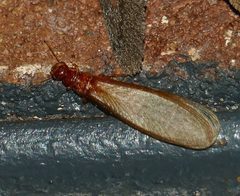
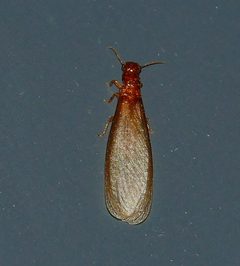
Reproductive occur in July and August.
Diet
Dry wood; cellulose from dead woody plant material. Specifically feeds mainly on dead branches of Parkinsonia florida (blue palo verde). Derives all required water from wood digestion.
Host Associations
- Parkinsonia florida - primary food sourcedead branches
Life Cycle
Simple with no true . hatch into nymphs that develop into pseudergates (false workers), which later differentiate into soldiers or winged reproductives. Colony founding is slow: after one year, offspring number between zero and twelve individuals. Colony expansion occurs through haphazard gallery construction within the wood piece.
Behavior
Colonies are entirely contained within a single piece of timber. Reproductives walk across substrate after mating to locate existing holes or crevices in dry wood, which they may enlarge but do not create de novo. Entrance sealed with faecal plug within one to three days of pairing. Faecal pellets expelled through temporary "kick holes" to exterior, then holes resealed. Abandoned chambers filled with faecal pellets and desiccated corpses.
Ecological Role
Decomposer of dead wood in arid environments; contributes to nutrient cycling in desert . Gut harbors approximately forty symbiotic microorganisms to digest cellulose from dry timber.
Human Relevance
Potential pest of structural timbers in buildings within its range.
Similar Taxa
- Marginitermes hubbardiBoth are drywood termites in the Sonoran Desert, but M. hubbardi primarily feeds on saguaro skeletal remains rather than woody branches, and P. occidentis soldiers are distinguished by their V-shaped pronotal notch and prominent eyespots.
More Details
Gut symbionts
All colonies harbor approximately forty symbiotic microorganisms, suggesting this diversity is necessary for survival on nutritionally poor dry timber.
Soldier morphology
Soldiers possess rounded flat-topped , large wingbuds, massive pronotum with V-shaped notch, and prominent eyespots—features distinguishing them from regional .
Reproductive morphology
Winged reproductives have large black with white eyespots immediately above; and orange; pronotum relatively flat without downward curvature at sides.