
Fasciosminthurus quinquefasciatus
(Krausbauer, 1898)
zebra springtail
Fasciosminthurus quinquefasciatus, commonly known as the zebra springtail, is a originally from Eurasia that has established worldwide, including North America. It is distinguished by its distinctive striped coloration and is frequently observed in urban and disturbed .
Pronunciation
How to pronounce Fasciosminthurus quinquefasciatus: /fæsiɒsmɪnˈθjʊərəs kwɪŋkwɪfæsiˈætəs/
These audio files are automatically generated. While they are not always 100% accurate, they are a good starting point.
Identification
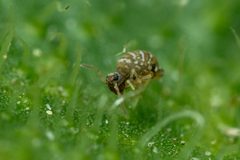
Distinguished from similar springtails by the distinctive zebra-like pattern of white stripes outlined in black on a brown body. The 4-segmented and globular body shape typical of Symphypleona are additional diagnostic features.
Images
Appearance
Body brown with white stripes outlined by black stripes, creating a zebra-like pattern. have 4 segments.
Habitat
Primarily found in gravel trails and similar urban localities. Frequently observed in disturbed, anthropogenic environments.
Distribution
Native to Eurasia; introduced and established in North America, Australia, and other regions worldwide. GBIF records indicate presence in Europe, Macaronesia (Faial), Mediterranean region, and northern and eastern Australia.
Diet
Feeds on wood and dead plant matter ().
Ecological Role
Decomposer; contributes to nutrient cycling through consumption of dead plant material and wood.
Human Relevance
An introduced in many regions; commonly encountered in urban environments such as gravel trails. No known direct economic or medical significance.
Similar Taxa
- Other BourletiellidaeSimilar globular body form, but distinguished by the unique zebra-striped coloration pattern of F. quinquefasciatus
More Details
Taxonomic Note
The specific epithet 'quinquefasciatus' (meaning 'five-banded') refers to the striped pattern, though the 'zebra springtail' emphasizes the overall visual effect rather than a precise count of stripes.
Global Spread
This exemplifies the distribution pattern seen in many springtails, having spread from its native Eurasian range to multiple continents, likely through human-mediated transport in soil and plant materials.
Sources and further reading
- BugGuide
- Wikipedia
- GBIF taxonomy match
- iNaturalist taxon
- Catalogue of Life
- Are Culex Mosquitoes Potential Vectors of the Zika Virus? | Bug Squad
- Breaking News: Zika Virus Found in Wild-Caught Culex | Bug Squad
- UC Davis Team: Mosquito Odorant Receptors Are Sensitive to Floral Compunds | Bug Squad
- Anthony Cornel Knows Mosquitoes | Bug Squad
- Gas Station Windshield Wash Basins: Yet Another Habitat for Mosquito Larvae
- Plant Pollen May Be Important Food Source for Some Mosquitoes in U.S.