
Vesicephalus occidentalis
(Mills, 1935)
globular springtail
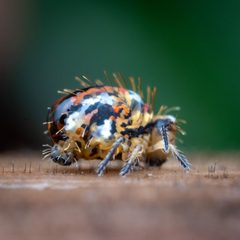
Vesicephalus occidentalis is a of globular springtail in the Katiannidae. It belongs to the order Symphypleona, characterized by a rounded, globular body form. The species was described by H.B. Mills in 1935. As a , it possesses a (springing organ) that enables leaping locomotion. The species is part of the diverse of soil-dwelling microarthropods.
Pronunciation
How to pronounce Vesicephalus occidentalis: /ˌvɛ.sɪˈsɛ.fə.ləs ˌɒk.sɪˈdɛn.tə.lɪs/
These audio files are automatically generated. While they are not always 100% accurate, they are a good starting point.
Identification
Distinguished from other globular springtails by characteristics of the Katiannidae, including specific arrangements of setae and body . Separation from congeneric requires examination of chaetotaxy (bristle arrangement) and detailed morphological features of the , , and . Accurate identification typically requires microscopic examination.
Images
Appearance
Body globular and rounded, typical of Symphypleona. As a member of Katiannidae, likely small (under 2 mm), with reduced or absent pigmentation. The is present, folded beneath the when at rest. relatively short. smooth or with fine setation.
Habitat
Soil-dwelling microarthropod inhabiting the litter layer and upper soil horizons. As a globular springtail, likely found in moist microhabitats including decaying organic matter, leaf litter, and soil crevices. Specific microhabitat preferences within these zones are not well documented.
Distribution
North America; specifically recorded from the Pacific North American region and northern North America. Distribution records indicate presence in western and northern portions of the continent.
Behavior
Capable of leaping using the , a characteristic for avoidance and . As a soil microarthropod, likely exhibits cryptic habits, remaining concealed in soil and litter during unfavorable conditions.
Ecological Role
Contributes to soil dynamics as a decomposer or microbivore. Participates in nutrient cycling through consumption of fungal , bacteria, or decaying organic matter. Serves as prey for larger soil arthropods and other .
Human Relevance
No documented direct economic or medical significance. Like other springtails, contributes to soil health and functioning, indirectly supporting agriculture and natural vegetation through nutrient cycling activities.
Similar Taxa
- Other Katiannidae speciesShare globular body form and -level characteristics; require detailed morphological examination for separation
- Other Symphypleona families (e.g., Sminthuridae)Similar globular body shape and springing locomotion; distinguished by -specific antennal structure, body , and chaetotaxy patterns
More Details
Taxonomic Note
The epithet 'occidentalis' (western) reflects its geographic distribution in western North America. The Vesicephalus is placed in the tribe Vesicephalini within Katiannidae.
Sources and further reading
- BugGuide
- Wikipedia
- GBIF taxonomy match
- iNaturalist taxon
- Catalogue of Life
- Bumble Bees: Feeling Impact of Climate Change | Bug Squad
- Probing the Molecular Interactions Between Western Flower Thrips and the Tomato Spotted Wilt Virus | Bug Squad
- Flabellate Grasshopper
- Ticks Can Do More Than 'Tick You Off' | Bug Squad
- Good News for the Western Bumble Bee, Bombus occidentalis
- A sting to kill a cow? Red velvet ant, a.k.a. cow killer, Dasymutilla occidentalis — Bug of the Week