
Podura aquatica
Linnaeus, 1758
water springtail
Podura aquatica, commonly known as the water , is one of only four described in the Poduridae. It is exclusively aquatic, living its entire life on the surface of still water bodies where it scavenges. The species exhibits specialized sensory adaptations for locating water surfaces through polarized light detection. possess a large, flattened that enables jumping without breaking water surface tension. The species has a Holarctic distribution and is considered abundant across its range.
Pronunciation
How to pronounce Podura aquatica: //pɒˈdjʊərə əˈkwætɪkə//
These audio files are automatically generated. While they are not always 100% accurate, they are a good starting point.
Identification
Distinguished from other springtails by its exclusive association with water surfaces. Differs from Hypogastruridae, which also occur in standing water, by its longer tail (). The large, flattened furcula is diagnostic for aquatic surface locomotion. Positive and polarotaxis to horizontally polarized light in the blue range are behavioral traits used in location. The combination of small size (≤1.5 mm), bluish-grey to black coloration, and water surface habitat separates it from terrestrial springtails.
Images
Appearance
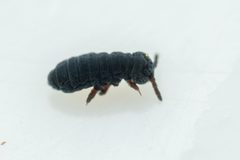
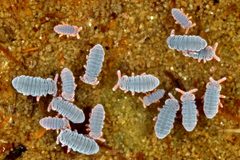
Small, squat up to 1.5 mm in length. Body coloration typically bluish-grey, occasionally almost black. The is notably large and flattened, an for aquatic surface locomotion. The is very thin (1–10 μm) with a endocuticle and epicuticle; thicker regions (8–10 μm) contain a distinct sclerotized exocuticle. The outer cuticular surface features major of approximately 3 μm pitch with superimposed minor tubercles. The contains 6 with horizontal and vertical microvilli, while the eye has 2 upward-looking ommatidia with vertical microvilli.
Habitat
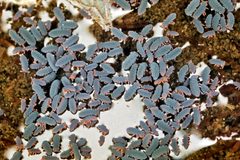
Exclusively aquatic, inhabiting the surface film of all types of still water bodies. Accumulates in the immediate vicinity of riparian vegetation. Requires calm water surfaces for locomotion and foraging.
Distribution
Holarctic distribution, occurring across Arctic and Sub-arctic regions, Europe, the Mediterranean, northern Eurasia, and northern North America.
Seasonality
Active year-round where water surfaces remain unfrozen; specific seasonal patterns not documented in available sources.
Diet
Scavenger on water surfaces; specific food items not documented in available sources.
Life Cycle
are deposited on the water surface, hydrophilic, and sink immediately to the bottom. Embryonic development occurs underwater. Hatchlings possess a hydrophobic and rise to the water surface to complete post-embryonic development. are deposited on the water surface. Intermoult cuticle formation involves distinct epicuticle, exocuticle (where present), and endocuticle layers.
Behavior
Exhibits positive with peak spectral sensitivity in the blue (≈484 nm) and green-yellow (≈570 nm) ranges. Displays strong polarotaxis to horizontally polarized light in the blue range, used to locate suitable water surfaces. Horizontally polarized light attracts more individuals than unpolarized light even when 10 times dimmer. Threshold of polarization sensitivity is between 10.1% and 25.5%. Uses the large, flattened to jump on water surfaces without breaking surface tension.
Ecological Role
Scavenger on water surfaces; specific functions not documented in available sources.
Human Relevance
Used as a model organism in studies of polarized light detection and aquatic insect sensory . No documented economic or medical significance.
Similar Taxa
- HypogastruridaeCommon springtails in standing water, but distinguished by shorter tail () and lack of specialized aquatic surface adaptations.
More Details
Sensory ecology
P. aquatica is one of the few non-insect hexapods known to use polarized light for detection, convergent with many aquatic insects. The 's polarization sensitivity functions even when the is slightly tipped down on a raised surface, facilitating water detection from varied postures.
Cuticle ultrastructure
Electron microscopy reveals the consists of epicuticle (1–4 laminae: inner, cuticulin, wax, cement), endocuticle (), and exocuticle (in thicker regions). The contains black pigment . Specialized cuticular modifications occur at setal bases and muscle insertions.
Sources and further reading
- BugGuide
- Wikipedia
- GBIF taxonomy match
- iNaturalist taxon
- NCBI Taxonomy
- Catalogue of Life
- Marronoids: The (Mostly) Little Brown Spiders With a Big Story to Tell
- Northern Ireland, invertebrate finds in review 2023 - Buglife Blog - Buglife
- Pseudoscorpiones | Beetles In The Bush
- Research Showcases Best and Brightest Fathers of the Insect World
- Swim Lessons: How Two Land-Dwelling Ant Species Paddle Through Water
- Cicindela cursitans in Missouri | Beetles In The Bush
- The fully formed intermoult cuticle and associated structures of Podura aquatica (Collembola)
- Orientation of Podura Aquatica (L.) (Collembola, Insecta) in a Natural Angular Radiance Distribution
- Polarization sensitivity in Collembola: an experimental study of polarotaxis in the water-surface-inhabiting springtail,Podura aquatica
- How does the water springtail optically locate proper habitats? Spectral sensitivity of photo- and polarotaxis inPodura aquatica