
Hypogastrura nivicola
Fitch, 1847
snow flea, dark blue springtail
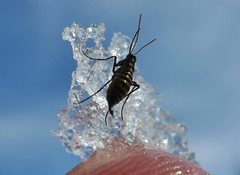
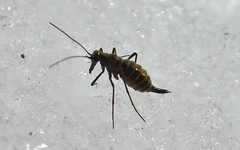
Hypogastrura nivicola is a small, dark blue commonly known as the snow flea in North America. Despite its , it is unrelated to true fleas and belongs to the ancient group Collembola, which predates the first vertebrates on land by millions of years. The is notable for its ability to remain active on snow surfaces during winter, enabled by glycine-rich antifreeze proteins that prevent ice crystal formation in its tissues. It possesses the characteristic springtail anatomy including a for jumping and a .
Pronunciation
How to pronounce Hypogastrura nivicola: /hɪpoʊˈɡæstrərə ˈnɪvɪˌkoʊlə/
These audio files are automatically generated. While they are not always 100% accurate, they are a good starting point.
Identification
Distinguished from other snow-dwelling arthropods by its tiny size, dark blue color, and jumping . Unlike true fleas (Siphonaptera), snow fleas have six legs (not six legs as with fleas being laterally compressed), lack the laterally compressed body of fleas, and possess the -specific and . May be confused with other Hypogastrura or dark globular springtails (Sminthuridae) on snow; microscopic examination of chaetotaxy and body proportions required for definitive species identification. The related snow scorpionflies (Boreidae, e.g., Boreus hyemalis) are wingless but have different body proportions and do not jump using a furcula.
Images
Habitat
Primarily found in forest floor leaf litter where multiply; migrates to snow surfaces during winter. Requires moist conditions for survival. Observed in tight-knit colonies that migrate unidirectionally across forest floor during spring and autumn, navigating around obstacles such as tree stumps.
Distribution
North America; specifically recorded from Vermont and other regions of the United States. Associated with temperate forest with seasonal snow cover.
Seasonality
Active year-round with peak visibility on snow during warm winter days. Colonies migrate across forest floor during spring and autumn days, dispersing locally at nightfall. springtails continue molting throughout life, with up to 50 recorded.
Diet
Feeds on decaying vegetation, bacteria, fungi, and biofilm. Unlike true fleas, does not parasitize animals or feed on blood.
Life Cycle
involves males depositing (sperm packets) on substrate, sometimes on hair-like stalks, which females locate and pick up. Females lay individually or in small clusters in soil. Development involves simple/: hatchlings resemble miniature and undergo multiple . Adults continue molting throughout their lifespan, possibly due to cuticular respiration requirements. No pupal stage.
Behavior
Uses mechanism for jumping: the furcula is cocked and held by a retinaculum (clasp), then released to catapult the animal several times its body length. Forms dense on snow surfaces. Colonial of single colonies recorded up to 25 meters across forest floor; function of this unknown. Minuscule sac-like organs project from the hind gut prior to jumping, speculated to aid in jump mechanics, organ protection, or .
Ecological Role
Decomposer and nutrient recycler in forest soil . Member of soil fauna instrumental in breaking down organic matter and recycling nutrients. Serves as prey for various soil-dwelling . High densities (200-1,800 per cubic decimeter of forest soil) indicate significant contribution to soil .
Human Relevance
No economic or medical importance; not a pest, , or . Subject of scientific research due to unique glycine-rich antifreeze proteins, which have potential biomedical applications for organ preservation and food technology (ice cream production). Research at 's University (Canada) sequenced and synthesized these proteins, which prevent ice crystal formation in tissues and break down easily at higher temperatures unlike similar proteins in other .
Similar Taxa
- Boreus hyemalis (snow scorpionfly)Also called 'snow flea' and active on snow in winter, but belongs to order Mecoptera; wingless with different body plan, lacks , and has different locomotion
- Other Hypogastrura speciesRequire microscopic examination for definitive identification; share similar preferences and
- Sminthuridae (globular springtails)Also found on snow in late winter; differ in body shape (more globular vs. elongate in Hypogastrura) and taxonomic placement
Misconceptions
Despite the 'snow flea,' this is not a true (order Siphonaptera) and is unrelated to the blood-feeding of mammals and birds. The name derives solely from its jumping and winter activity on snow. Not all springtails jump; the common name applies specifically to those with functional mechanisms.
More Details
Antifreeze protein research
The glycine-rich antifreeze protein of H. nivicola has been sequenced and synthesized by researchers at 's University. Unlike antifreeze proteins in fish and other organisms that remain stable at higher temperatures, this protein breaks down easily above freezing, potentially making it more suitable for applications requiring temporary ice crystal inhibition.
Hind gut sacs
Minuscule sac-like organs project from the hind gut immediately prior to jumping. Their function remains speculative: hypotheses include protecting internal organs from impact forces, aiding in jump mechanics, or dispersing . More research is needed to confirm their purpose.
Taxonomic note
Some sources list Yosii, 1960 as author, but Fitch, 1847 is the accepted authority. The has been treated as a synonym of Hypogastrura (Hypogastrura) tepli in some classifications.