
Orchesella cincta
(Linnaeus, 1758)
Belted Springtail
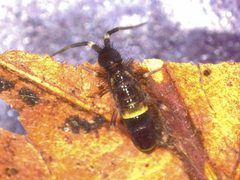
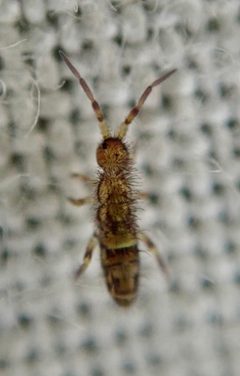
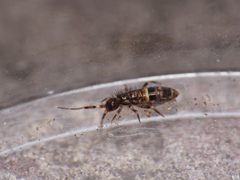
Orchesella cincta is a relatively large , averaging 4 mm in length—substantially larger than most springtails, which typically remain under 1 mm. The species is distinguished by its distinctive 'belted' coloration, with a darkly pigmented third abdominal segment contrasting against lighter adjacent segments. Native to Western Europe and North America, it has also been introduced to Saint Helena. This springtail exhibits notable physiological plasticity, including with evolved heavy metal from contaminated mining sites.
Pronunciation
How to pronounce Orchesella cincta: //ɔːr.kɛˈsɛl.lə ˈsɪŋk.tə//
These audio files are automatically generated. While they are not always 100% accurate, they are a good starting point.
Identification
reach approximately 4 mm in length, making them among the largest springtails. The third abdominal segment is distinctly dark pigmented (the 'belt' referenced by the specific epithet), while the part of the second abdominal segment is white. The third antennal segment is dark, contrasting with the white part of the second antennal segment; fifth and sixth antennal segments are brown. Overall body coloration is variable, ranging from reddish-brown through various brown shades to blackish. The body is densely covered with setae. frequently appear unequal in length, possibly due to developmental damage. Members of the Orchesella possess six antennal segments.
Images
Habitat
Soil and leaf litter in woodland environments. Can be maintained in laboratory settings on twigs covered with green .
Distribution
Western Europe (Norway, Sweden, Switzerland, France, The Netherlands, British Isles including Scotland, England, Wales, and Ireland); Canada; introduced and established on Saint Helena in the mid-Atlantic.
Diet
: feeds on live and dead plant tissue, mosses, , and lichens; also consumes fungi and bacteria.
Life Cycle
Springtails moult throughout their entire life. In this , feeding instars and reproductive instars alternate. When environmental conditions are unfavorable (dry conditions, low temperatures), reproductive phases can be postponed until conditions improve, at which point reproductive activity becomes synchronized across the .
Behavior
Exhibits higher mobility than many , with greater likelihood of spreading into new microhabitats such as plant foliage and tree crevices. When disturbed, uses the (forked tail-like appendage) to flip into the air.
Ecological Role
Decomposer and nutrient cycler in soil and leaf litter systems. surges following favorable conditions allow rapid exploitation of available resources.
Human Relevance
Used as a model organism in ecotoxicology research, particularly for studying heavy metal and effects. from metal-contaminated mining sites have evolved heritable cadmium tolerance with altered profiles, making this valuable for studying microevolutionary processes in soil arthropods.
Similar Taxa
- Other Orchesella speciesShare six antennal segments and general body plan; distinguished by the specific pigmentation pattern of the third abdominal segment and third antennal segment in O. cincta
- Smaller springtail speciesMost springtails are under 1 mm; O. cincta at 4 mm is substantially larger, though size alone is not definitive without examination of abdominal pigmentation
More Details
Heavy metal tolerance
from metal-contaminated mining sites exhibit field-selected to cadmium and other heavy metals. This tolerance involves heritable increased metal , reduced cadmium-induced growth reduction, and constitutive overexpression of metallothionein genes and other stress-responsive genes. Tolerant populations maintain normal under cadmium exposure, while reference populations show -wide expression perturbation.
Introduction to Saint Helena
Established on Saint Helena in the mid-Atlantic, presumably introduced accidentally with plant material.
Sources and further reading
- BugGuide
- Wikipedia
- GBIF taxonomy match
- iNaturalist taxon
- NCBI Taxonomy
- Catalogue of Life
- Grasshoppers of Colorado
- Grasshoppers of Colorado
- Grasshoppers of Colorado
- Species Records and Accounts
- Celebrate Moths at the Bohart Museum on Saturday Night, July 30 | Bug Squad
- Trilogy of Terror | Beetles In The Bush
- Effects of atrazine on growth and reproduction of Orchesella cincta (Collembola)
- Faculty Opinions recommendation of Adaptive differences in gene expression associated with heavy metal tolerance in the soil arthropod Orchesella cincta.
- Differential gene expression profiles associated with heavy metal tolerance in the soil insect Orchesella cincta
- Genetic Variation and Covariation for Characteristics Associated with Cadmium Tolerance in Natural Populations of the Springtail Orchesella cincta (L.)
- GENETIC VARIATION AND COVARIATION FOR CHARACTERISTICS ASSOCIATED WITH CADMIUM TOLERANCE IN NATURAL POPULATIONS OF THE SPRINGTAILORCHESELLA CINCTA(L.)