
Orchesellinae
Börner, 1906
Genus Guides
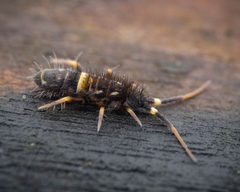
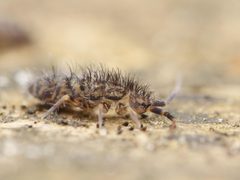
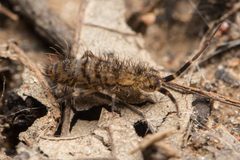
2Orchesellinae is a of springtails (Collembola) in the Orchesellidae. Members are distinguished from other Entomobryidae by a fourth abdominal segment shorter than 1.8 times the length of the third segment, generally more than four antennal segments, recurved labral setae, and a complex metatrochanteral organ bearing at least 11 spine-like setae. The subfamily includes such as Dicranocentrus, Australotomurus, and Orchesellides, with distributions ranging from holotropical to Australian and disjunct patterns.
Pronunciation
How to pronounce Orchesellinae: /ɔrkɛsɛˈliːnae/
These audio files are automatically generated. While they are not always 100% accurate, they are a good starting point.
Identification
Distinguished from other Entomobryidae by the combination of: short fourth abdominal segment (ratio <1.8× third segment), >4 antennal segments, recurved labral setae, and complex metatrochanteral organ with ≥11 spine-like setae. Within Orchesellinae, differ in antennal segmentation, patch lens number, shape, pre-labral setae structure, and male secondary sexual character placement on antennal segments.
Images
Appearance
Fourth abdominal segment short (length at midline less than 1.8 times third segment). with generally more than four segments. Labral setae recurved. Metatrochanteral organ complex, with at least 11 spine-like setae. Body often with present.
Distribution
Holotropical distribution documented for some (e.g., Dicranocentrus). Australotomurus to Australia, with in long undisturbed native grasslands and heathland at low and high elevations. Disjunct distribution patterns observed in Orchesellides.
Similar Taxa
- Other EntomobryidaeOrchesellinae differs by shorter fourth abdominal segment, more antennal segments, recurved labral setae, and complex metatrochanteral organ
- PseudodicranocentrusSimilar scaled Orchesellini ; distinguished by simple vs. bifurcated pre-labral setae
- DicranorchesellaSimilar scaled Orchesellini ; distinguished by rounded/truncated vs. pointed
More Details
Taxonomic Note
Orchesellinae has been variously placed in Entomobryidae or Orchesellidae depending on classification system used. Catalogue of Life and NCBI currently place it in Orchesellidae; some sources retain it in Entomobryidae.
Conservation Concern
Australotomurus morbidus is the only in its currently vulnerable to extinction due to restricted distribution to four urban remnant localities subject to human disturbance.
Sources and further reading
- BugGuide
- iNaturalist taxon
- NCBI Taxonomy
- Catalogue of Life
- A Revision of the Genus Australotomurus (Collembola: Entomobryidae: Orchesellinae)
- A new species of Dicranocentrus Schött (Collembola, Entomobryidae, Orchesellinae) from Brazilian Amazon
- A DISJUNCT DISTRIBUTION FOR A NEW SPECIES OF ORCHESELLIDES (COLLEMBOLA, ENTOMOBRYIDAE, ORCHESELLINAE)
- Description and conservation status of a new species of Australotomurus (Collembola: Entomobryidae: Orchesellinae) from urban Perth remnant bushland