
Coecobrya tenebricosa
(Folsom, 1902)
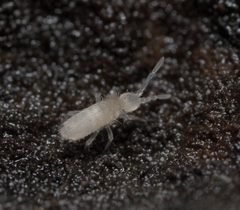
Coecobrya tenebricosa is a cave-dwelling in the Entomobryidae. It belongs to the tenebricosa-group, characterized by the absence of , an unguis with one unpaired tooth, and a manubrium lacking smooth . The species has been recorded from multiple disjunct regions including the Caribbean mainland, Europe, Hawaii, Macaronesia, and the Mediterranean.
Pronunciation
How to pronounce Coecobrya tenebricosa: /ˌsiːkoʊˈbraɪə ˌtɛnəˈbrɪkɔːsə/
These audio files are automatically generated. While they are not always 100% accurate, they are a good starting point.
Identification
in the tenebricosa-group, including C. tenebricosa, are distinguished from other Coecobrya by the combination of: absence of (eyeless condition); unguis bearing one unpaired tooth; and manubrium without smooth . Within the tenebricosa-group, C. tenebricosa differs from similar species (C. communis, C. edenticulata, C. tropicalis) in details of chaetotaxy, mesothoracic chaetotaxy, and chaetotaxy.
Images
Habitat
Cave-dwelling (troglobitic). As a member of the tenebricosa-group, this is adapted to subterranean environments.
Distribution
Recorded from Caribbean mainland, Europe, Hawaii, Macaronesia, and the Mediterranean region. The wide geographic disjunction of these records suggests either a broader natural distribution than currently understood or potential human-mediated .
Similar Taxa
- Coecobrya communisShares tenebricosa-group characteristics including eyelessness, unguis with one unpaired tooth, and manubrium without smooth ; distinguished by , mesothoracic, and chaetotaxy details
- Coecobrya edenticulataShares tenebricosa-group characteristics including eyelessness, unguis with one unpaired tooth, and manubrium without smooth ; distinguished by , mesothoracic, and chaetotaxy details
- Coecobrya tropicalisShares tenebricosa-group characteristics including eyelessness, unguis with one unpaired tooth, and manubrium without smooth ; distinguished by , mesothoracic, and chaetotaxy details
More Details
Taxonomic History
Originally described as Sinella tenebricosa by Folsom in 1902, later transferred to Coecobrya. The Coecobrya was established by Yosii.
Group Characteristics
The tenebricosa-group within Coecobrya represents a morphologically cohesive of cave-adapted showing convergent troglobitic adaptations including reduction or loss and specialized chaetotaxy patterns.
Sources and further reading
- BugGuide
- GBIF taxonomy match
- iNaturalist taxon
- NCBI Taxonomy
- Catalogue of Life
- Are Trees in Species-Rich Urban Plantings Less Susceptible to Pest Damage?
- The Warmer the Better: Gloomy Scale Can Be a Big Problem on Urban Landscape Trees
- Museum Specimens Show How Scale Insects Will Respond To Climate Change
- City Heat Boosts Tree-Killing Scale Insect Populations
- Why a Little Bit of This Tree Pest is a Good Thing in Urban Landscapes
- Scale Insects on Urban Trees Benefit Spiders, Other Natural Enemies in Plants Below
- A new cave species of Coecobrya Yosii (Collembola, Entomobryidae, Entomobryinae) from South Africa, with an identification key to the genus