Acartiidae
Sars G.O., 1903
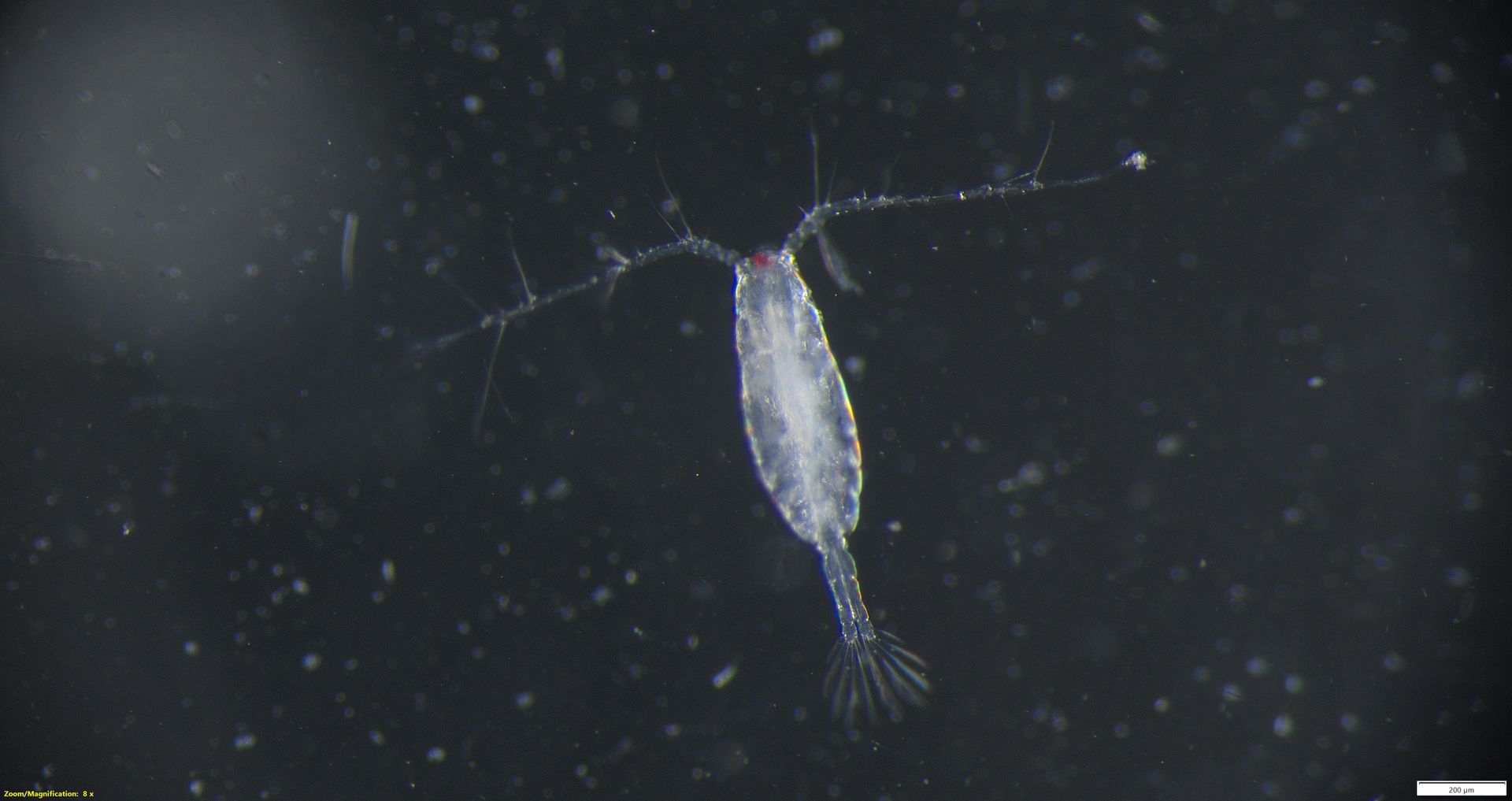
Acartiidae is a of calanoid copepods comprising over 100 described distributed throughout the world's oceans, predominantly in temperate regions. Members are epipelagic planktonic organisms that do not occur below 500 meters depth. The family is taxonomically distinguished by a rostral margin that is not extended. Species within Acartiidae are predominant and widespread in estuarine and coastal waters, though individual species typically exhibit restricted spatio-temporal distributions.
Pronunciation
How to pronounce Acartiidae: /əˈkɑːrtɪ.aɪˌdiː/
These audio files are automatically generated. While they are not always 100% accurate, they are a good starting point.
Identification
Distinguished from other calanoid copepod by the rostral margin not being extended. Family-level identification requires microscopic examination of cephalic appendage . -level identification within Acartiidae is complicated by morphological similarity among ; genetic analysis (mtCOI sequences showing 0-3% divergence) has been used to distinguish cryptic species such as A. ohtsukai and A. pacifica.
Images
Habitat
Epipelagic marine and brackish waters; estuarine and coastal environments. Upper water column , not found below 500 meters depth. Some occupy specific salinity : low saline continental brackish waters versus euryhaline to coastal marine waters.
Distribution
Worldwide in oceans, mainly in temperate areas. Distribution records from Denmark, Norway, and Sweden. Individual may have restricted ranges: for example, Acartia ohtsukai occurs in continental brackish waters of East Asia with a relict in the Ariake Sea, Western Japan, and has been recorded in Korean waters; Acartia pacifica is broadly distributed in tropical/subtropical Indo-West Pacific coastal waters.
Behavior
segregation observed between occupying different salinity regimes. Spatio-temporal distribution patterns differ among within the .
Ecological Role
Predominant zooplankton component in estuarine and coastal waters worldwide. Forms a major constituent of epipelagic plankton in temperate marine .
Sources and further reading
- BugGuide
- Wikipedia
- GBIF taxonomy match
- iNaturalist taxon
- NCBI Taxonomy
- Catalogue of Life
- Resting Eggs in the Life Cycle of Acartia Italica and a. Adriatica (Copepoda, Calanoida, Acartiidae)
- Acartia (Odontacartia) ohtsukai Ueda and Bucklin, 2006 (Copepoda, Calanoida, Acartiidae): First Record of its Occurrence in Korean Waters and Habitat Segregation from its Sibling Species A. pacifica Steuer, 1915