
Gammarus locusta
(Linnaeus, 1758)
scud
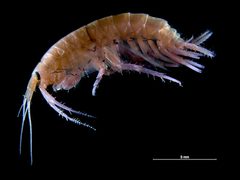
Gammarus locusta is a marine amphipod crustacean in the Gammaridae, commonly known as a scud. It inhabits coastal and estuarine environments with a distribution in European waters. The has been extensively studied as a model organism for ecotoxicology, particularly regarding responses to ocean acidification, warming, deoxygenation, and pharmaceutical contaminants. Research indicates it possesses the ability to biosynthesize or retain essential long-chain , making it of interest for aquaculture applications.


Pronunciation
How to pronounce Gammarus locusta: //ˈɡæmərəs loʊˈkʌstə//
These audio files are automatically generated. While they are not always 100% accurate, they are a good starting point.
Images
Habitat
Marine and estuarine environments, including coastal waters and estuaries. Associated with surface driftweed and benthic substrates. Has been documented in the Sado estuary (Portugal) and Galway Bay (Ireland). Demonstrates euryhaline capabilities, tolerating varying salinity conditions.
Distribution
distribution in European coastal and estuarine waters. Documented from the eastern Atlantic including Ireland, Portugal, and other European localities.
Diet
Feeds on macroalgae including Fucus sp., Ulva sp., Laminaria sp., Gracilaria sp., and Chondrus sp. Capable of consuming agri-food industry sidestreams such as carrot leaves and coconut flesh, though with variable growth performance.
Life Cycle
Direct development without larval stages. Juveniles predominate in throughout the year. Breeding activity peaks during summer but continues at low levels for most of the year. parameters are affected by temperature and salinity, with implications for laboratory culture conditions.
Behavior
Exhibits chemosensory-dependent mate detection using long-distance female cue detection. Males demonstrate response time, directional movement, activity rate, and time spent in female scent cues as measurable behavioral parameters. Shows avoidance toward olivine substrates in the context of ocean alkalinity enhancement. Juveniles use drifting as a medium for expansion and as from . No diel vertical has been detected.
Ecological Role
Human Relevance
Used extensively as a model organism in ecotoxicological research, particularly for studying effects of ocean acidification, warming, deoxygenation, and pharmaceutical pollution. Investigated as a potential sustainable ingredient for aquaculture feeds due to its ability to accumulate long-chain . growth and are sensitive to environmental contaminants including simvastatin and triclocarban at environmentally relevant concentrations.
Similar Taxa
- Gammarus duebeniBoth are euryhaline gammarid amphipods with overlapping , but G. duebeni shows greater osmoregulatory plasticity with significant changes in apparent water permeability under varying salinity, whereas G. locusta exhibits larger bulk flow and different osmoregulatory responses.
- Chaetogammarus marinusCo-occurring euryhaline amphipod with distinct osmoregulatory characteristics; G. locusta shows intermediate responses between G. duebeni and C. marinus in salinity studies.
Sources and further reading
- BugGuide
- Wikipedia
- GBIF taxonomy match
- iNaturalist taxon
- NCBI Taxonomy
- Catalogue of Life
- Grasshoppers of Colorado
- Grasshoppers of Colorado
- Are cicadas locusts? Locusta spp. and Magicicada spp. — Bug of the Week
- ID Challenge #2 | Beetles In The Bush
- Life history of the amphipod Gammarus locusta in the Sado estuary (Portugal)
- Haemolymph Concentration and Apparent Permeability in Varying Salinity Conditions of Gammarus Duebeni, Chaetogammarus Marinus and Gammarus Locusta
- Chronic effects of triclocarban in the amphipod Gammarus locusta : Behavioural and biochemical impairment
- Transgenerational exposure to deoxygenation and warming disrupts mate-detection in Gammarus locusta
- The subtle effects of sea water acidification on the amphipod Gammarus locusta
- Transgenerational exposure to deoxygenation and warming disrupts mate detection in Gammarus locusta
- The subtle effects of sea water acidification on the amphipod Gammarus locusta
- The anti-lipidemic drug simvastatin modulates Epigenetic Biomarkers in the Amphipod Gammarus locusta
- Effects of Temperature and Salinity on Life History of the Marine Amphipod Gammarus locusta. Implications for Ecotoxicological Testing
- Eutrophication-induced changes in benthic algae affect the behaviour and fitness of the marine amphipod Gammarus locusta
- Effects of diet and temperature on the fatty acid composition of the gammarid Gammarus locusta fed alternative terrestrial feeds
- The Ecology of Idotea Species (Isopoda) and Gammarus Locusta (Amphipoda) on Surface Driftweed in Galway Bay (West of Ireland)
- Olivine avoidance behaviour by marine gastropods (Littorina littorea L.) and amphipods (Gammarus locusta L.) within the context of ocean alkalinity enhancement
- Hypocholesterolaemic pharmaceutical simvastatin disrupts reproduction and population growth of the amphipod Gammarus locusta at the ng/L range
- Fatty acid profile of Gammarus locusta newly hatched offspring from the wild and from adults farmed on mono-specific macroalgal diets