
Portunus
Weber, 1795
Species Guides
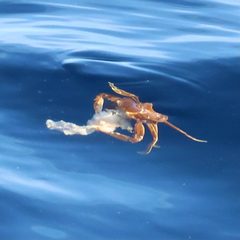
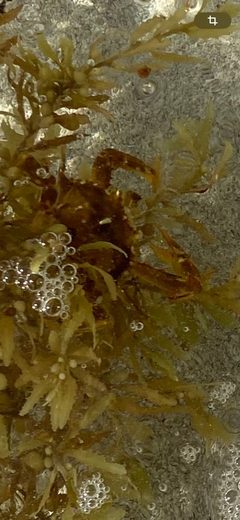
1- Portunus sayi(Sargassum Swimming Crab)
Portunus is a of swimming crabs ( Portunidae) established by Weber in 1795. The genus comprises 13 extant and 26 fossil species, with a geological record spanning from the Paleogene to recent times. Several species are commercially important, including the blue swimming crab (Portunus pelagicus) and the Gazami crab (Portunus trituberculatus). Fossil evidence indicates a broad historical distribution across Europe, North America, South America, and Australia.
Pronunciation
How to pronounce Portunus: /ˈpɔr.tu.nus/
These audio files are automatically generated. While they are not always 100% accurate, they are a good starting point.
Images
Habitat
Marine coastal and offshore waters. Specific studies document in shallow coastal waters such as Betahwalang waters in Demak, Central Java, and Osaka Bay. Some utilize drifting seaweed as a substrate for .
Distribution
Extant occur in marine waters of the Indo-Pacific region, with specific documented in Central Java (Indonesia) and Osaka Bay (Japan). Fossil species are known from sediment deposits in Europe, the United States, Mexico, Venezuela, Brazil, and Australia, dating from 48.6 million years ago to present.
Seasonality
Activity patterns vary by and location. In Osaka Bay, Portunus sanguinolentus appears from June to January, with ovigerous females present from August to January. In Central Java, fishing activity occurs year-round with peak female abundance in July and August.
Host Associations
- drifting seaweed - substrate for juvenilesJuveniles of Portunus sanguinolentus observed arriving in Osaka Bay attached to drifting seaweed from the Kii Channel
Life Cycle
Juveniles of some utilize drifting seaweed for to new . Rapid growth occurs through winter months, with Portunus sanguinolentus reaching average widths of approximately 140 mm (males) and 130 mm (females) by winter. experience mass mortality when water temperatures fall below approximately 12°C. in size has been documented, with males and females showing different growth patterns.
Behavior
Attachment to drifting vegetation for passive during stage. Some exhibit rapid growth rates through winter. Temperature-dependent mortality occurs at approximately 12°C in studied populations.
Ecological Role
Important fisheries resource for coastal . In Betahwalang, Central Java, serves as the main fisheries product supporting local livelihoods and sustainable fisheries management.
Human Relevance
Several are targets of commercial and artisanal fisheries, including the blue swimming crab and Gazami crab. The three-spotted crab is caught as bycatch. Fisheries activity occurs almost daily in some regions, with catch data used for sustainable management planning.
More Details
Fossil Record
The has a substantial fossil record with 26 known only from fossils, indicating long evolutionary history and former broader geographic distribution.
Sources and further reading
- BugGuide
- Wikipedia
- GBIF taxonomy match
- iNaturalist taxon
- NCBI Taxonomy
- Catalogue of Life
- Distribution and Size of Crab (Portunus pelagicus) in Betahwalang Waters, Demak, Central JavaSex Ratio, Size Distribution and Length-Weight Relationship of Portunus pelagicus Linnaeus, 1758 (Malacostraca : Portunidae) in Betahwalang, Demak, Central Java
- Life History of the Red-spotted Swimming Crab Portunus (Portunus) sanguinolentus in Osaka Bay