
Dissodactylus
Smith, 1870
pea crab
Species Guides
1- Dissodactylus mellitae(Sand Dollar Pea Crab)
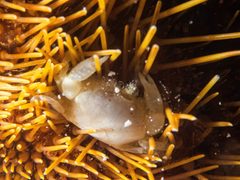
Dissodactylus is a of pea crabs in the Pinnotheridae, comprising at least 20 described . Species in this genus are obligate ectosymbionts of echinoid , primarily sand dollars. The genus shows geographic variation in larval development: Pacific species have four zoeal stages, while Atlantic species have three. Several species have been studied for their host-finding , which rely on chemical cues to locate specific echinoid hosts.
Pronunciation
How to pronounce Dissodactylus: /ˌdɪs.oʊˈdæk.tɪ.ləs/
These audio files are automatically generated. While they are not always 100% accurate, they are a good starting point.
Identification
Small-bodied crabs with reduced width, typically under 8 mm in . Distinguished from the related Clypeasterophilus by adult morphological features, particularly palp size: Dissodactylus possess "large-palped" versus the "small-palped" condition in Clypeasterophilus. Larval stages of Pacific species (D. xantusi, D. lockingtoni, D. nitidus) are morphometrically and meristically similar, requiring examination of spine length on the carapace and chromatophore patterns for identification.
Images
Habitat
Marine benthic environments, specifically shallow sand bottoms in the infralittoral zone. Occurs exclusively in association with echinoid , living as ectosymbionts on the external surfaces or within the body cavity of sand dollars and other irregular echinoids.
Distribution
Widespread in coastal marine waters of the Americas. Pacific occur from California to tropical eastern Pacific, associated with including Encope grandis, E. californica, E. micropora, and Mellita longifissa. Atlantic species occur along the eastern coasts of North and South America, including the southeastern Brazilian coast.
Seasonality
Recruitment occurs year-round in some , with peak recruitment documented in March for D. crinitichelis in Brazil. Breeding period extends across multiple months with ovigerous females present in population from August through July.
Host Associations
- Encope emarginata - ectosymbiont for D. crinitichelis
- Encope grandis - ectosymbiont for D. xantusi, D. lockingtoni, D. nitidus
- Encope californica - ectosymbiont for D. xantusi, D. lockingtoni, D. nitidus
- Encope micropora - ectosymbiont for D. xantusi, D. lockingtoni, D. nitidus
- Mellita longifissa - ectosymbiont for D. xantusi, D. lockingtoni, D. nitidus
- Mellita quinquiesperforata - ectosymbiont for D. mellitae
- Meoma ventricosa - ectosymbiont for D. primitivus
Life Cycle
Development includes four zoeal stages and a megalopa stage in Pacific (D. xantusi, D. lockingtoni, D. nitidus), with total larval duration of approximately 15 days from hatching to megalopa in D. xantusi. Atlantic species have three zoeal stages. Complete to crab occurs after settlement on .
Behavior
Uses chemical stimuli to navigate toward and locate specific echinoid . Host-finding has been demonstrated in D. primitivus and D. crinitichelis, with crabs responding to waterborne cues from host Meoma ventricosa and chemical signals. Laboratory-reared larvae show -specific settlement preferences.
Ecological Role
Obligate ectosymbiont of irregular echinoids, forming intimate associations with sand dollar . structure suggests spatial segregation by size class within host populations. Potential competitive interactions with other pinnotherid documented where host ranges overlap.
Similar Taxa
- ClypeasterophilusFormerly included within Dissodactylus; distinguished by "small-palped" versus "large-palped" condition in Dissodactylus, and by larval characteristics. Recently separated based on morphological and developmental differences.
Sources and further reading
- BugGuide
- Wikipedia
- GBIF taxonomy match
- iNaturalist taxon
- NCBI Taxonomy
- Catalogue of Life
- Dissodactylus xantusi and Dissodactylus lockingtoni (Decapoda: Brachyura: Pinnotheridae): larval development of two sympatric Pacific species
- Distribution and abundance of Dissodactylus mellitae Rathbun (Pinnotheridae) on Mellita quinquiesperforata (Leske) (Echinodermata)
- Exploring chemical stimuli guiding the pea crab Dissodactylus primitivus towards its echinoid host Meoma ventricosa
- Host selection, host-use pattern and competition in Dissodactylus crinitichelis and Clypeasterophilus stebbingi (Brachyura: Pinnotheridae)
- Chemical recognition in the symbiotic pea crab Dissodactylus crinitichelis (Crustacea: Decapoda: Pinnotheridae): host and conspecific cues
- Population dynamics and reproduction of Dissodactylus mellitae (Brachyura: Pinnotheridae) on its sand dollar host Mellita quinquiesperforata (Echinodermata)
- Symbiosis between the pea crab Dissodactylus primitivus and its echinoid host Meoma ventricosa: potential consequences for the crab mating system
- Population features of the pea crab Dissodactylus crinitichelis Moreira, 1901 (Decapoda, Brachyura, Pinoteridade) associated with the sand-dollar Encope emarginata (Echinodermata, Echinoidea) in the southeastern Brazilian coast