
Uca minax
(Le Conte, 1855)
red-jointed fiddler crab, brackish-water fiddler crab
Minuca minax is a fiddler crab distinguished by its for low-salinity and freshwater , extending farther inland than most . Males possess one greatly enlarged claw with red joints, the source of its . Formerly classified in Uca, it was transferred to Minuca in 2016. The species is abundant in salt marshes and tidal streams along the U.S. Atlantic and Gulf coasts, with documented occurring more than 50 km from the sea.
Pronunciation
How to pronounce Uca minax: /ˈjuːkə ˈmɪnæks/
These audio files are automatically generated. While they are not always 100% accurate, they are a good starting point.
Identification
Distinguished from other fiddler crabs by the combination of: (1) red joints on the claws, visible in both sexes; (2) occurrence in lower salinity than , including freshwater; and (3) inland distribution extending far up tidal rivers. Overlaps with Uca pugnax in the 8–12 ppt salinity range, but M. minax extends into fresher water while U. pugnax dominates higher salinities (21–29 ppt).
Images
Appearance
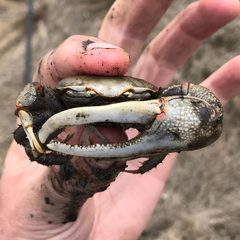
Males have one claw significantly larger than the other; females have two equal-sized smaller claws. The joints on the claws are red, a distinctive and noticeable feature. Overall body form typical of fiddler crabs with a square-shaped .
Habitat
Tidal streams and salt marshes, particularly in areas of reduced salinity. Strongly associated with substrates high in organic content, despite these having low oxygen levels. Occupies burrows that provide stable thermal microenvironments buffered from air temperature fluctuations. Can occur at distances greater than 50 km from the sea in tidally influenced river systems.
Distribution
United States Atlantic and Gulf coasts from Massachusetts to the Gulf of Mexico. Documented in Delaware Bay tidal tributaries, Pee Dee River/Winyah Bay system (South Carolina), and Virginia estuaries.
Life Cycle
Larvae develop in marine or high-salinity planktonic environments, as they cannot survive in the low-salinity brackish water preferred by . Larvae exhibit flood-tide transport : avoiding ebb tides and actively swimming during flood tides to move upstream within estuaries. Late-stage larvae recruit to freshwater adult . Adults do not travel to the sea to release larvae; instead, larvae use selective tidal-stream transport to reach appropriate developmental habitats.
Behavior
Males construct small round burrows for summer breeding periods. At high densities, reduces intraspecific encounter and competition by burrowing and subsequently covering burrow entrances. Exhibits substrate selection , preferentially occupying high-organic-content substrates in both field and laboratory conditions.
Ecological Role
One of the most common macroinvertebrates in salt marshes throughout its range. As a burrowing organism in organic-rich substrates, likely contributes to sediment aeration and nutrient cycling in marsh .
Similar Taxa
- Uca pugnaxOverlaps in distribution and salinity ; both equally abundant at 8–12 ppt salinity. Distinguished by M. minax's red claw joints and extension into fresher water, versus U. pugnax's dominance at higher salinities (21–29 ppt).
- Uca pugilatorLess terrestrial with reduced cuticular permeability compared to M. minax; M. minax's reduced cuticular permeability specifically promotes inland expansion and freshwater survival not seen in U. pugilator.
More Details
Taxonomic history
Originally described as Gelasimus minax by Le Conte in 1855. Long classified in Uca, but transferred to genus Minuca in 2016 when Minuca was elevated from subgeneric status. Still frequently referenced as Uca minax in older literature and some databases.
Genetic population structure
Study of 226 from four locales along 49 km of the Pee Dee River/Winyah Bay estuary found statistically significant subdivision, supporting model predictions that opposing forces of river discharge and tidal amplitude limit larval within tidally influenced river systems.
Sources and further reading
- BugGuide
- Wikipedia
- GBIF taxonomy match
- iNaturalist taxon
- NCBI Taxonomy
- Catalogue of Life
- Celebrating the15th Anniversary of the UC Davis Bee Haven | Bug Squad
- Did Anyone Say "Insect-Vectored Pathogens?" | Bug Squad
- The Day That Cockroaches Stole the Show | Bug Squad
- It's All the Buzz: 4-H'ers Learning How to Keep Bees | Bug Squad
- Ground-Breaking Research: Sex Pheromone of Asian Citrus Psyllid Discovered | Bug Squad
- CAMBP Classes on Pollinator Gardens and Apiary Technology | Bug Squad
- Certain organism-substrate relationships affecting the distribution of Uca minax (Crustacea: Decapoda)
- Distribution of the Fiddler Crabs, Uca pugnax and Uca minax, in Relation to Salinity in Delaware Rivers
- Limited gene flow in Uca minax (LeConte 1855) along a tidally influenced river system
- Distribution of the Fiddler Crab (Uca minax) in Relation to Marsh Plants within a Virginia Estuary
- Waving display and sound production in the courtship behavior of Uca pugilator, with comparisons to U. minax and U. pugnax
- Recruitment to adult habitats following marine planktonic development in the fiddler crabs, Uca pugilator, U. pugnax, and U. minax
- Developmental shift in the selective tidal-stream transport behavior of larvae of the fiddler crab Uca minax (LeConte)
- Reduced Cuticular Permeability Promotes Inland Habitat Expansion and Freshwater Survival in the Fiddler Crab Uca Minax but not in its Less Terrestrial Counterparts U. Pugilator and U. Pugnax