
Libinia emarginata
Leach, 1815
portly spider crab, common spider crab, nine-spined spider crab
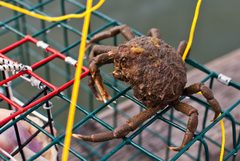
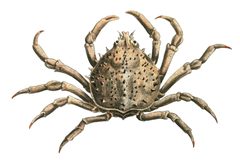
Libinia emarginata is a heavily calcified spider crab native to the western Atlantic coast of North America. It is characterized by its triangular , khaki coloration, and distinctive spiny appearance. The exhibits unusual forward- locomotion rather than the typical sideways movement of most crabs. As a decorator crab, it frequently covers itself with debris and small for camouflage.
Pronunciation
How to pronounce Libinia emarginata: /lɪˈbɪniə ɛˌmɑrdʒɪˈneɪtə/
These audio files are automatically generated. While they are not always 100% accurate, they are a good starting point.
Identification
Distinguished from the sympatric Libinia dubia by the number of spines along the midline: L. emarginata has nine spines, while L. dubia has only six. The rostrum of L. emarginata is less deeply forked than that of L. dubia. The triangular body shape and heavy calcification separate it from most other regional crab .
Images
Appearance
Roughly triangular in outline with a heavily calcified . approximately 100 mm long with a leg span reaching 300 mm. Uniform khaki coloration. Carapace surface covered with spines and , bearing nine spines along the central midline. Frequently adorned with attached debris, , sponges, and small . Younger individuals often more heavily decorated than .
Habitat
Marine benthic environments on various substrates including sand, mud, and shell bottoms. Occurs in coastal and continental shelf waters. typically found at depths up to 46–49 m, with exceptional records to 120 m. Younger crabs frequently associated with sponge and hydroid colonies.
Distribution
Western Atlantic Ocean from Nova Scotia, Canada southward through the Florida Keys and throughout the Gulf of Mexico.
Seasonality
Mating and production occur from June through September. Larval release follows approximately 25 days of egg development.
Diet
Known to feed on large starfish including Asterias forbesi, despite its relatively small size compared to other predatory crabs.
Host Associations
- Asterias forbesi - preylarge starfish
Life Cycle
are initially bright orange-red, darkening to brown during approximately 25 days of development. Hatch as zoea larvae. Females can produce successive within 12 hours of larval release, unlike many crab where females mate only immediately after molting.
Behavior
are sluggish and non-aggressive. Exhibits unusual forward- locomotion preferentially, though capable of sideways movement when necessary—distinctive among crabs and supported by skeletal, muscular, and neural anatomy resembling forward-walking rather than related sideways-walking crabs. Males display protective "obstetrical " where gravid females about to release larvae are held behind the male and aggressively defended. Mating occurs in large that may function as protective mechanisms during .
Ecological Role
on echinoderms and other benthic . Serves as substrate for epibiont , particularly in younger individuals. Participates in nutrient cycling through benthic interactions.
Human Relevance
No significant commercial fishery. Occasionally encountered in trawl bycatch. Subject of scientific interest due to unusual locomotory and reproductive .
Similar Taxa
- Libinia dubiaSympatric and morphologically similar; distinguished by six (vs. nine) midline spines and more deeply forked rostrum
More Details
Stenohaline physiology
The is stenohaline, meaning it has limited to salinity variation and is restricted to marine environments.