
Calappa
Weber, 1795
box crabs, shame-faced crabs
Species Guides
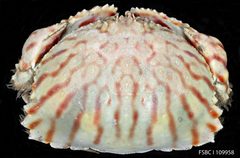
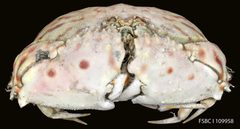
1- Calappa flammea(Flame Streaked Box Crab)
Calappa is a of marine crabs in the Calappidae, commonly known as box crabs or shame-faced crabs. The "box crab" derives from their characteristically bulky, often rounded , while "shame-faced crab" refers to the posture of their large chelae (claws), which fold up to cover the front of the body as if hiding the . within this genus exhibit highly specialized claw adapted for shell-opening , primarily feeding on gastropod mollusks. The genus has a broad geographic distribution across tropical and subtropical marine waters, with both extant and fossil records documented from the Miocene to present.

Pronunciation
How to pronounce Calappa: /kəˈlæpə/
These audio files are automatically generated. While they are not always 100% accurate, they are a good starting point.
Identification
Calappa are distinguished from other calappid crabs by their robust, often box-like that is typically broader than long, with a rounded or arched outline. The most distinctive feature is the markedly asymmetrical chelipeds: the right claw is enlarged and modified with a broad, flat tooth on the dactyl and paired on the propodus, specialized for crushing gastropod shells; the left claw has elongated, pointed fingers for extracting prey. The chelae fold tightly over the carapace, concealing the mouthparts. Carapace ornamentation varies by species and may include , , or smooth areas; fresh coloration ranges from pale to reddish-brown.
Images
Habitat
Marine benthic environments, primarily on soft substrates including sand, detritus bottoms, and muddy sediments. Some occur on mixed substrates of sand with rock and boulders. Depth range varies by species: commonly reported from shallow coastal waters to upper continental shelf depths (approximately 50–150 m), with some records from deeper waters.
Distribution
Tropical and subtropical marine waters worldwide. Extant documented from the Indo-Pacific (including Philippines, East China Sea, southern Taiwan Strait), eastern Pacific (southeastern Gulf of California), and Atlantic-Mediterranean regions (central and eastern Mediterranean, Adriatic Sea). Fossil records extend the temporal range to the Middle Miocene, with specimens reported from Italy, Hungary, Poland, Austria, Malta, Spain, and Pliocene-Pleistocene Mediterranean localities.
Diet
Gastropod mollusks (snails) are the primary prey, accessed through specialized shell-opening . Stomach content analysis of C. granulata indicates additional consumption of crustaceans (20.28%), cephalopods (10.58%), fish (3.4%), and shellfish (0.28%). C. ocellata has been observed feeding on the mussel Brachidontes domingensis.
Life Cycle
with separate sexes. Reproductive documented in several : females carry on pleopods (berried condition). C. convexa reproduces year-round with peaks from April to August; mean of 638,885 eggs per female. C. philargius exhibits twin spawning events in January–April and August–October, with peak in February. C. granulata size at 50% female maturity estimated at 66.92 mm length, males at 59.25 mm.
Behavior
Highly specialized shell-opening using asymmetrical claws: the right claw applies crushing force to the gastropod shell aperture, while the left claw extracts the soft body or enclosed hermit crab. This represents a distinct feeding among brachyuran crabs. C. hepatica has been documented as a "nuclear " in a temporary feeding association with the flowery flounder Bothus mancus in the Indo-Pacific, where the crab's foraging activity exposes prey for the fish.
Ecological Role
of shelled mollusks and other benthic . The specialized shell-opening allows exploitation of gastropod resources unavailable to many other predators. As a nuclear , C. hepatica facilitates opportunistic foraging by predatory fishes. Epibiotic associations documented: serpulid polychaetes recorded on C. granulata with 29.3% .
Human Relevance
Subject to commercial and artisanal fisheries in several regions. C. convexa is commonly caught as by-catch in spiny lobster (Panulirus spp.) gillnet fisheries in southern Sinaloa, Mexico. C. philargius supports an increasing claw-only fishery in China, with claws yielding approximately 36.28% of whole body weight; whole-body and claw-only trade documented using trawl and trap gears. C. granulata and other occasionally appear in Mediterranean fisheries.
Sources and further reading
- BugGuide
- Wikipedia
- iNaturalist taxon
- NCBI Taxonomy
- Catalogue of Life
- New records of Calappa tuerkayana Pastore, 1995 (Brachyura, Calappidae) from the central Mediterranean Novi nalaz vrste Calappa tuerkayana Pastore, 1995 (Brachyura, Calappidae) u središnjem Sredozemlju
- Shell Opening by Crabs of the Genus Calappa
- Calappa praelata Lőrenthey in Lőrenthey & Beurlen, 1929 (Decapoda, Brachyura, Calappidae) from the Middle Miocene of Tresnuraghes (Oristano, Sardegna, Italy)
- The Box Crab Calappa hepatica as a Nuclear Species for the Opportunistic Foraging Behaviour of the Flowery Flounder, Bothus mancus, in the Indo-Pacific
- Biology and fishery of the arched box crab Calappa convexa de Saussure (Crustacea, Brachyura, Calappidae) In the Southeastern Gulf of California, Mexico
- Population, Reproductive and Fishery Dynamics of Spotted Box Crab (Calappa philargius), a New Claw-Only Fishery Species, in the Southern Taiwan Strait, China
- Revealing the Shamefaced Crab Calappa granulata (Crustacea: Brachyura) from the Adriatic Sea, Northern Basin of the Mediterranean
- New records of two uncommon species, Calappa tuerkayana Pastore, 1995 (Decapoda, Calappidae) and Parasquilla ferrussaci (Roux, 1828) (Stomatopoda, Parasquillidae), from the Strait of Sicily (central Mediterranean Sea)
- New report of the box crab <em>Calappa granulata</em> (Linnaeus, 1758) from the Pliocene of Borgomanero (NW Italy), with remarks on its fossil distribution
- Foraging behaviour of a tropical crab: Calappa ocellata Holthuis feeding upon the mussel Brachidontes domingensis (Lamarck)
- On some Modifications of Structure subservient to Respiration in Decapod Crustacea which burrow in Sand; with some remarks on the Utility of Specific Characters in the genus Calappa, and the description of a new species of Albunea
- Conserved Gene Order and Adaptive Evolution in Mitochondrial Genomes of Calappa Crabs: Insights Into Ecological Specialization and Phylogenetic Utility.
- The complete mitogenome of Calappa japonica ortmann, 1892 (Decapoda: Calappidae) from the East China Sea.