
Calappidae
De Haan, 1833
Box Crabs
Genus Guides
1- Calappa(box crabs)
Calappidae is a of marine crabs commonly known as box crabs, comprising approximately 16 including both extant and fossil . Seven genera are known only from the fossil record, with calappid fossils documented from the Cretaceous to Recent (66.043 Ma to present) across Europe, the United States, Mexico, Central America, Australia, and Japan. The family is characterized by a distinctive box-like and is distributed in tropical and temperate marine waters worldwide.
Pronunciation
How to pronounce Calappidae: /kəˈlæpɪˌdaɪ/
These audio files are automatically generated. While they are not always 100% accurate, they are a good starting point.
Identification
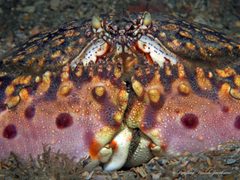
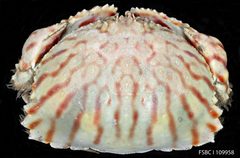
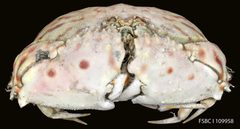
Distinguished from other crab by the highly vaulted, box-like and large, often asymmetrical crushing chelipeds. The family can be separated from the related family Matutidae by phylogenetic and morphological characters. -level identification requires examination of carapace ornamentation, cheliped , and coloration patterns.
Images
Appearance
Box crabs possess a distinctive broad, rounded to oval that is often highly vaulted, giving a box-like appearance. The carapace is typically ornamented with , spines, or ridges. Chelipeds are large, often asymmetrical, and adapted for crushing. The legs are relatively short and stout. Some exhibit carapace width:length relationships that vary between sexes, with females becoming relatively narrower at larger sizes.
Habitat
Marine benthic environments ranging from shallow coastal waters to depths exceeding 100 meters. Substrates include sand, rock, boulders, and detritus bottoms. Calappa convexa has been documented on sand, rock, and boulders with highest abundance on rocky substrate (43% of catch per unit effort). Calappa tuerkayana occurs on detritus bottoms at 50–105 m depth.
Distribution
Worldwide distribution in tropical and temperate marine waters. Fossil record spans Europe, United States, Mexico, Central America, Australia, and Japan from Cretaceous to Recent. Extant occur in the Atlantic, Pacific, and Indian Oceans including the Mediterranean Sea (four species), eastern Pacific (Mexico, Panama), western Atlantic (Brazil), and East China Sea.
Seasonality
Activity and catch rates vary seasonally in some regions. In the southeastern Gulf of California, maximum catch of Calappa convexa occurred in June, with minimum catches in December and March. Reproductive peaks occur from April to August in this . Matuta lunans shows seasonal patterns in size distribution with modal classes shifting from spring to winter.
Life Cycle
Development includes planktonic larval stages typical of decapod crabs, though specific details for most calappid are not documented. Moulting occurs throughout the year in some species, with individuals capable of moulting after reaching sexual maturity.
Behavior
An unusual has been reported in box crabs, though specific details are not available from the provided sources. Calappa convexa is commonly caught as bycatch in gillnets targeting spiny lobsters, suggesting benthic foraging behavior.
Human Relevance
Calappa convexa is exploited as a local fishing resource in southern Sinaloa, Mexico, where it is caught as bycatch in spiny lobster (Panulirus spp.) gillnet fisheries. The supports a small- fishery with variable catch per unit effort (0.81–9.10 g/100m²/h). Some calappid species are occasionally caught in trawl and trammel net fisheries.
Similar Taxa
- MatutidaeHistorically related of box crabs; distinguished by phylogenetic relationships and morphological characters. Matutidae and Calappidae together form the superfamily Calappoidea.
More Details
Fossil Record
Calappidae has an extensive fossil record with seven known only from fossils. The is documented from Cretaceous to Recent sediments across multiple continents, indicating long evolutionary history and wide paleogeographic distribution.
Reproductive Biology
occurs year-round in some with seasonal peaks. Calappa convexa females carry an average of 638,885 . Hepatus pudibundus exhibits continuous reproduction with ovigerous females present in all sampled months, with no clear relationship to water temperature.
Phylogenetic Studies
The of box crab has been investigated with attention to fossil record, , and depth distribution patterns, though specific findings are not detailed in the provided sources.
Sources and further reading
- BugGuide
- Wikipedia
- GBIF taxonomy match
- iNaturalist taxon
- NCBI Taxonomy
- Catalogue of Life
- An Unusual Behaviour in Box Crabs (Decapoda, Brachyura, Calappidae)
- New records of Calappa tuerkayana Pastore, 1995 (Brachyura, Calappidae) from the central Mediterranean Novi nalaz vrste Calappa tuerkayana Pastore, 1995 (Brachyura, Calappidae) u središnjem Sredozemlju
- Reproductive biology of the sandy shore crab Matuta lunans (Brachyura: Calappidae)
- Distribution and Abundance of the Family Calappidae Off the Coast of Jalisco and Colima, Mexico
- The phylogeny of box crab genera (Crustacea: Brachyura: Calappidae) with notes on their fossil record, biogeography and depth distribution
- Reproductive cycle of Hepatus pudibundus (Herbst, 1785) (Crustacea, Decapoda, Calappidae) in Ubatuba, SP, Brazil
- Biology and fishery of the arched box crab Calappa convexa de Saussure (Crustacea, Brachyura, Calappidae) In the Southeastern Gulf of California, Mexico
- Description of the Male and New Distribution Records for Acanthocarpus Delsolari Garth, 1973 (Decapoda, Calappidae) From the Pacific Coast of Panama
- The complete mitogenome of Calappa japonica ortmann, 1892 (Decapoda: Calappidae) from the East China Sea.