
Pagurus longicarpus
Say, 1817
long-clawed hermit crab, long-wristed hermit crab
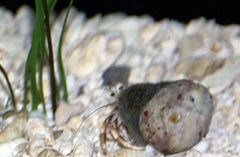
Pagurus longicarpus is a small hermit crab reaching up to 12.7 mm in shell length. It inhabits empty gastropod shells, primarily those of periwinkles, oyster drills, and mud snails. The species is distributed along the Atlantic coast of North America from Nova Scotia to Florida and westward to Texas, including the Gulf of Mexico. It occupies intertidal and subtidal to depths of 200 meters, with seasonal movements between shallow tidal pools in warmer months and deeper waters in winter.
Pronunciation
How to pronounce Pagurus longicarpus: //pəˈɡuːrəs lɒnˈdʒɪkɑːrpəs//
These audio files are automatically generated. While they are not always 100% accurate, they are a good starting point.
Identification
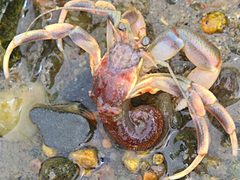
Distinguished from similar hermit crabs by the pronounced asymmetry of the claws, with the right claw markedly larger than the left. The distinctive claw stripes provide additional diagnostic characters. Shell occupancy in small gastropod shells (periwinkles, oyster drills) at small body size separates it from larger hermit crab .
Images
Appearance
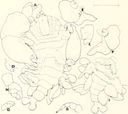
Body coloration varies, commonly gray, green, or white. The right claw is substantially larger than the left claw. Each claw bears a distinct tan or gray longitudinal stripe down the center. The is soft and asymmetrical, adapted to coil around the columella of gastropod shells.
Habitat
Found in intertidal and subtidal marine environments. Occupies a variety of substrates. Occurs in shallow tidal pools during April through October, migrating to deeper, warmer waters during fall and winter. Tidal pool experience extreme fluctuations in temperature and salinity due to tidal inundation, solar heating, and freshwater input from precipitation.
Distribution
Western Atlantic Ocean from Nova Scotia, Canada to northeastern Florida, USA. Gulf of Mexico coast from Florida to Texas. Established reported in the North Frisian Wadden Sea (North Sea), likely introduced via trans-Atlantic larval transport in ballast water.
Seasonality
Active in shallow tidal pools from April to October. Moves to deeper waters during fall and winter months. Breeding season extends from late March through October, with peak activity in April.
Diet
Scavenger feeding on detritus, organic material from ocean surface foam, microcrustaceans, and . Feeding involves scooping substrate with chelipeds, tearing food, and passing it to mouthparts.
Host Associations
- Littorina spp. - uses empty shellperiwinkle shells
- Urosalpinx cinerea - uses empty shelloyster drill shells
- Ilyanassa obsoleta - uses empty shelleastern mud snail shells
Life Cycle
Development includes planktonic larval stages: zoea, megalops, and , before reaching adulthood. Larvae are released into the water column where they undergo these stages prior to settlement. Females within their shells; eggs attach to pleopods. Sexual internal requires both sexes to partially emerge from shells.
Behavior
for shells is frequent and often aggressive. Larger individuals or those with suboptimal shells may forcibly evict occupants from preferred shells by grasping the resident's legs with their pincers. Shell size affects feeding —individuals in improperly sized shells may cease feeding, leading to starvation. Shell selection influences growth rate and reproductive success, with larger shells correlating with higher reproductive output. Precopulatory mate guarding occurs, with males grasping female shells after detecting maturity .
Ecological Role
Scavenger contributing to detritus processing in intertidal and subtidal . Shell occupation creates for other organisms in empty shells. Serves as prey for birds, fish, snails, octopuses, and other crabs including the green crab (Carcinus maenas).
Human Relevance
Used as in recreational fishing. Subject of ecological research on shell competition and intertidal dynamics. Introduced in European waters (Wadden Sea) represents a potential case study in marine invasion .
Similar Taxa
- Pagurus bernhardusLarger body size; occupies different shell types; different geographic range (Northeast Atlantic)
- Clibanarius erythropusBright red and distinct stalk coloration; more timid ; different claw
More Details
Shell Damage and Predation Risk
Shells with holes caused by naticid gastropod drilling are avoided due to increased vulnerability to . Shell condition significantly influences individual survival and .
European Introduction
First recorded in the North Frisian Wadden Sea in 2022, representing a trans-Atlantic range extension likely mediated by ballast water transport of larvae.