
Cryptolithodes sitchensis
Brandt, 1853
Umbrella Crab, Sitka Crab, Turtle Crab
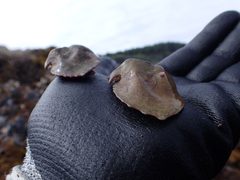
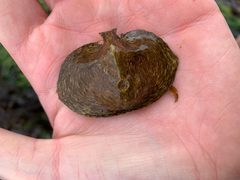
Cryptolithodes sitchensis is a lithodid crab native to the northeastern Pacific coast. Its is notably expanded, extending over the legs and chelipeds to form a protective cover. When the legs are retracted, the crab resembles a small stone. It was described by Johann Friedrich von Brandt in 1853 from a specimen collected near Sitka, Alaska.

Pronunciation
How to pronounce Cryptolithodes sitchensis: //ˌkrɪptoʊˈlaɪθoʊdiːz sɪˈtʃɛnsɪs//
These audio files are automatically generated. While they are not always 100% accurate, they are a good starting point.
Identification
Distinguished from other Cryptolithodes by the highly expanded that completely covers the legs. The stone-like appearance when retracted is diagnostic. Can be separated from C. typicus and C. expansus by carapace proportions and degree of lateral expansion. The abdominal plate arrangement, particularly the accessory plates on the third segment, aids in identification; count and asymmetry of these plates differ between sexes.
Images
Habitat
Rocky substrates from low intertidal zone to subtidal depths. Found on rocky areas and presumably under rocks or in crevices given its stone-mimicking .
Distribution
Northeastern Pacific Ocean: Sitka, Alaska to Point Loma, California. East Pacific region.
Behavior
Retracts legs beneath the expanded , producing a stone-like appearance that likely serves as camouflage against .
Similar Taxa
- Cryptolithodes typicusCongeneric with less expanded ; does not produce the complete stone-mimicking appearance of C. sitchensis
- Cryptolithodes expansusCongeneric ; differs in degree of expansion and proportions
More Details
Taxonomic history
Described by Johann Friedrich von Brandt in 1853 from a specimen collected near Sitka, Alaska. The specific epithet sitchensis refers to this type locality.
Depth range discrepancy
Sources report differing maximum depths: Wikipedia cites 37 m (121 ft), while iNaturalist cites 17 m (56 ft). The shallower figure may reflect more commonly observed depths.