
Ricinoididae
Ewing, 1929
hooded tickspiders
Genus Guides
1- Pseudocellus(hooded tickspiders)
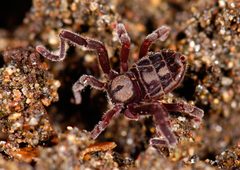
Ricinoididae is a of arachnids in the order Ricinulei, commonly known as hooded tickspiders. Members of this family are small, cryptic arachnids characterized by a distinctive hood-like structure (cucullus) that covers the mouthparts. The family represents one of the two extant families within the order, with found primarily in tropical regions of the Americas and Africa. Behavioral studies indicate predominantly activity patterns.
Pronunciation
How to pronounce Ricinoididae: //ˌrɪsɪˈnɔɪdɪˌdiː//
These audio files are automatically generated. While they are not always 100% accurate, they are a good starting point.
Identification
Ricinoididae can be distinguished from the other extant ricinuleid (Ricinuleidae) by genitalic and leg structure; males possess a complex spermatopositor and females a spermatheca with distinctive . The cucullus (movable hood covering the and mouthparts) is present in all ricinuleids and serves as a diagnostic feature for the order. -level identification requires examination of genitalic structures and leg spination patterns.
Images
Distribution
Neotropical region and equatorial Africa; occur in tropical forest .
Diet
Predatory on small arthropods.
Behavior
Predominantly : resting dominates during photophase, while feeding and exploring occur primarily during scotophase. Males exhibit higher behavioral repertoire diversity than females and immatures. Most frequent include resting, exploring, and feeding.
Similar Taxa
- RicinuleidaeThe other extant in order Ricinulei; distinguished by differences in genitalic and leg structure.
Misconceptions
Despite the "hooded tickspiders," ricinuleids are not true spiders (Order Araneae) and are not closely related to ticks (Order Ixodida). The name refers to superficial morphological resemblance and the presence of the cucullus structure.
More Details
Behavioral research
The first detailed ethological study of a ricinuleid (Cryptocellus narino, Ricinoididae) documented 18 under laboratory conditions, establishing a baseline for ricinuleid activity patterns and demonstrating sex-based differences in behavioral complexity.