
Ricinulei
Thorell, 1876
hooded tickspiders, hooded tick-spiders
Family Guides
1- Ricinoididae(hooded tickspiders)
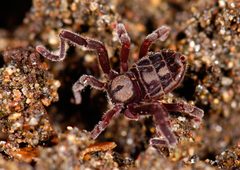
Ricinulei is a small order of arachnids comprising approximately 103 extant in a single , Ricinoididae. These heavily sclerotized, blind inhabit leaf litter and caves in tropical West Africa and the Americas. Their most distinctive feature is a movable 'hood' (cucullus) that covers the mouthparts when lowered. The order has an extensive fossil record spanning over 300 million years, with fifteen fossil species known from the Carboniferous and Cretaceous periods.
Pronunciation
How to pronounce Ricinulei: //ˌrɪsɪˈnjuːliː//
These audio files are automatically generated. While they are not always 100% accurate, they are a good starting point.
Identification
Ricinulei are distinguished from other arachnid orders by the presence of a cucullus—a hinged hood that can be raised or lowered over the prosoma. When lowered, this structure completely conceals the and mouth. They possess a heavily sclerotized, thick on both body and legs. The opisthosoma attaches to the prosoma via a narrow with a complex locking mechanism unique among arachnids. All extant lack , though fossil representatives retain evidence of lateral eye structures. Males possess uniquely modified third legs that function as copulatory organs; the shape of these structures is taxonomically diagnostic at the species level.
Images
Habitat
Extant ricinuleids occupy two primary types: leaf litter of tropical rainforest floors and caves. The African Ricinoides inhabits undisturbed, closed , mid-elevation evergreen forests. The American genera Cryptocellus and Pseudocellus occur in both leaf litter and cave systems, with at least one (Cryptocellus armasi) exhibiting troglomorphic adaptations including elongated appendages. Fossil evidence suggests Carboniferous representatives were surface-dwelling, unlike modern species.
Distribution
The order has a disjunct distribution across two landmasses. Ricinoides occurs in tropical West Africa from The Gambia and Senegal eastward to Congo and Gabon. Pseudocellus ranges from Panama through Central America and Mexico to southern Texas, USA, including Caribbean islands. Cryptocellus extends from Rondônia in western Brazil northward to Honduras. The fossil record includes Late Carboniferous deposits in Euramerica (Europe and North America) and Cenomanian Burmese amber from Myanmar.
Diet
Ricinuleids are predatory, feeding on small arthropods. Specific prey items documented in natural settings remain sparse; the diet is presumed to include various small encountered in leaf litter and cave .
Life Cycle
Ricinuleids exhibit direct development with maternal care. Females carry under the cucullus until hatching. Newly emerged young are six-legged larvae, a trait shared with Acari. The larvae subsequently into eight-legged . The six-legged larval stage represents a derived developmental among arachnids.
Behavior
Ricinuleids are . The second pair of legs, which are the longest, function as 'long-range' sensory organs extended forward during locomotion, analogous to . serve as 'short-range' sensory structures and manipulate food items. Males transfer to females using their modified third pair of legs. Individuals have been observed in large congregations; the function of these remains unknown. Non-mating social interactions between individuals have been documented.
Ecological Role
As small in leaf litter and cave , ricinuleids contribute to structure through on microarthropods. Their specific ecological functions and impacts have not been quantified.
Human Relevance
Ricinuleids have no documented economic or medical importance to humans. Their obscurity has prevented the establishment of a widely accepted , though 'hooded tickspiders' appears in academic literature. The order attracts scientific interest due to its unusual , extensive fossil record, and uncertain phylogenetic relationships.
Similar Taxa
- Opiliones (harvestmen)Historical misidentification; ricinuleids were originally classified as unusual harvestmen by early . Ricinuleids differ in possessing a cucullus, a narrow with locking mechanism, and six-legged larvae.
- Acari (mites and ticks)Proposed sister group relationship based on shared six-legged larval stage and morphological characters. Ricinuleids are readily distinguished by their large size, heavily sclerotized , cucullus, and leg .
- Trigonotarbida (extinct)Proposed sister group relationship based on shared opisthosomal tergite structure, body locking mechanism, and claw . Trigonotarbida is extinct; ricinuleids represent the only living arachnids with this combination of characters.
Sources and further reading
- BugGuide
- Wikipedia
- GBIF taxonomy match
- iNaturalist taxon
- NCBI Taxonomy
- Catalogue of Life
- They Created 'New Species' of Spiders | Bug Squad
- A new Amazonian Cryptocellus Westwood (Arachnida, Ricinulei)
- A new ricinuleid of the genus Ricinoides Ewing (Arachnida, Ricinulei) from Ghana
- A new species of Cryptocellus (Arachnida, Ricinulei) from the Kofán Territory in southwestern Colombia
- Cryptocellus armasi, a new troglomorphic hooded tick-spider from Venezuela (Arachnida, Ricinulei)
- Advances in Understanding the Karyotype Evolution of Tetrapulmonata and Two Other Arachnid Taxa, Ricinulei and Solifugae.