
Theridula gonygaster
(Simon, 1873)
Ladybird Spider
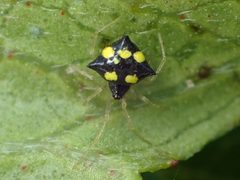
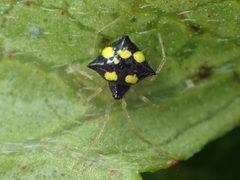
Theridula gonygaster is a of cobweb spider in the Theridiidae. Commonly known as the Ladybird Spider, it has a broad native range across Central and South America and the Caribbean, and has been introduced to multiple regions including parts of Europe, Africa, and Asia. The species is notable for its widespread anthropogenic and distinctive appearance.
Pronunciation
How to pronounce Theridula gonygaster: /tʰe.ɹɪˈduː.lə ɡo.nɪˈɡæs.təɹ/
These audio files are automatically generated. While they are not always 100% accurate, they are a good starting point.
Identification
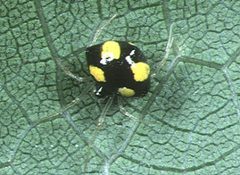
Distinguished from other Theridiidae by the combination of small size, rounded domed with ladybird-like spotted patterning, and cobweb-building . Separation from requires examination of genitalia; T. gonygaster has the widest distribution in the . Resembles ladybird beetles (Coccinellidae) in general form, but possesses eight legs and two body segments ( and abdomen) versus .
Images
Appearance
Small cobweb spider with a rounded, often brightly patterned . The 'Ladybird Spider' derives from coloration reminiscent of ladybird beetles (Coccinellidae), typically featuring contrasting spots or markings on a domed abdomen. Body compact with relatively short legs compared to body size. present, with females generally larger and more vividly patterned than males.
Habitat
Found in varied including tropical and subtropical vegetation, often in association with human-modified environments. Builds small, irregular cobwebs (tangle webs) typically in low vegetation, shrubs, or artificial structures. The ' successful establishment in introduced ranges suggests adaptability to diverse conditions.
Distribution
Native to Central and South America, Caribbean. Introduced and established in southwestern Europe, Democratic Republic of the Congo, Madagascar, Seychelles, Georgia, India, China, Japan, Cuba, and the United States (with records from Amazonas, Rio Grande do Sul, and São Paulo states in Brazil specifically noted).
Behavior
Constructs irregular cobweb or tangle webs for prey capture. The ' and coloration suggest possible protective mimicry of unpalatable ladybird beetles, though this has not been experimentally verified. web-building activity typical of .
Ecological Role
in web-based ; contributes to in both native and introduced ranges. Potential prey for larger and small vertebrates.
Human Relevance
Introduced indicate human-mediated , likely through shipping and trade. No documented medical or economic significance; not known to be venomous to humans. Presence in iNaturalist database with 389 observations indicates moderate public awareness and documentation effort.
Similar Taxa
- Coccinellidae (ladybird beetles)Convergent resemblance in body shape and coloration; distinguished by eight legs, two body segments, and web-building in Theridula versus six legs, hardened forewings (), and three body segments in beetles.
- Other Theridula speciesRequire genital examination for definitive separation; T. gonygaster distinguished by distribution pattern and subtle morphological differences.
More Details
Anthropogenic dispersal
The extensive introduced range of T. gonygaster across multiple continents is characteristic of spiders transported through global commerce, particularly in agricultural and horticultural trade. This pattern distinguishes it from more geographically restricted .