
Theridula
Emerton, 1882
Species Guides
3- Theridula emertoni(Emerton's Bitubercled Cobweaver)
- Theridula gonygaster(Ladybird Spider)
- Theridula opulenta(Cosmopolitan Bitubercled Cobweaver)
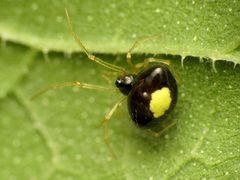
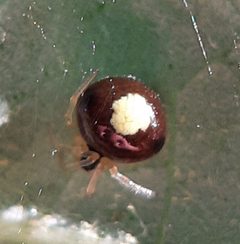
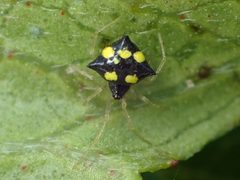
Theridula is a of small cobweb spiders (Theridiidae) distributed across tropical and temperate regions worldwide. range from 1 to 3.5 mm in body length. The genus is distinguished by distinctive abdominal in females and simplified male structure. Spiders in this genus are associated with vegetation, where they construct webs on the undersides of leaves.
Pronunciation
How to pronounce Theridula: /ˌθɛrɪˈduːlə/
These audio files are automatically generated. While they are not always 100% accurate, they are a good starting point.
Identification
Females identified by the wider-than-long with paired lateral projections (horns or humps) and potential horn. Males distinguished by simplicity: absence of conductor and theridioid tegular , features present in many related theridiid . Small size (under 4 mm) and cobweb web structure on vegetation aid field recognition.
Images
Habitat
Vegetation-associated; found on bushes and tall grass. Spiders rest on undersides of leaves near their webs. Specific microhabitat records include olive groves for some Mediterranean .
Distribution
with concentration in tropical regions. Documented from North America (USA, Canada, Mexico), Central America (Guatemala, Panama), South America (Brazil, Ecuador, Peru), Africa (Kenya, East Africa, Madagascar, St. Helena), Europe (Spain, Madeira, Greece), Mediterranean basin (Tunisia), and Asia (India, China, Japan). Some with cosmopolitan distributions (T. gonygaster, T. opulenta).
Behavior
Constructs cobweb webs on vegetation. Rests on undersides of leaves near web, a posture that may serve as avoidance or ambush positioning.
Similar Taxa
- Other Theridiidae generaTheridula males lack the conductor and theridioid tegular present in many related theridiid ; females distinguished by abdominal horn configuration.
More Details
Taxonomic note
The was established by Emerton in 1882. -level includes both widespread () and geographically restricted endemics. The Mediterranean species T. aelleni was recently recorded from Crete, extending its known range.