
Spintharus flavidus
Hentz, 1850
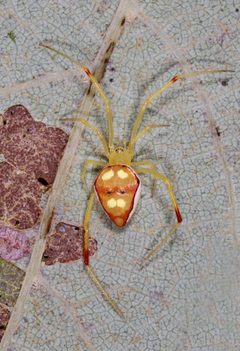
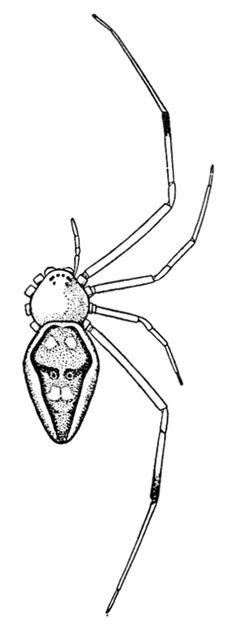
Spintharus flavidus is a cobweb spider in the Theridiidae, historically considered a single widespread ranging from northern North America to Brazil and throughout the Caribbean. Molecular phylogenetic analysis has rejected this hypothesis, revealing instead a 30 million year old radiation of at least 16 distinct species in the Caribbean region alone. Nearly all are short-range endemics with limited overwater ability. The Caribbean event occurred approximately 30 million years ago, coinciding with the GAARLandia landbridge hypothesis.
Pronunciation
How to pronounce Spintharus flavidus: /spɪnˈθɑːrəs ˈflævɪdəs/
These audio files are automatically generated. While they are not always 100% accurate, they are a good starting point.
Identification
Molecular data are required to distinguish the cryptic within this complex; morphological identification alone is unreliable given the historical lumping of multiple species under this name. The Spintharus is old, with its sister lineage Episinus documented in 45 million year old Baltic amber.
Images
Habitat
Occupies cryptic in leaf litter or on undersides of low-level leaves.
Distribution
Historically reported from northern North America to Bolivia, Brazil, and throughout the Caribbean. Molecular evidence indicates this range comprises a radiation of distinct : at least 16 in the Caribbean (nearly all short-range endemics or single island endemics), with additional distinct mainland groups in North, Central, and South America. GBIF records confirm presence in Trinidad and the USA, with Brazilian records from Amazonas, Pará, and Rio Grande do Sul.
Behavior
ability is limited. A single documented instance of ballooning (aerial dispersal on silk threads) has been observed, but the dispersal distance was short; long-distance overwater dispersal appears rare despite this capability.
Similar Taxa
- SpintharusThe contains only two described , with S. flavidus historically encompassing what molecular data now reveal to be at least 16 distinct Caribbean species plus mainland lineages. The other described species in the genus has not been subject to similar molecular revision.
Misconceptions
The primary misconception is that S. flavidus represents a single widespread capable of frequent overwater . Molecular phylogenetic analysis of three loci (COI, 16S, ITS2) from 195 individuals rejects this hypothesis, demonstrating instead that the name has been applied to a diverse radiation of short-range species with limited dispersal ability.
Sources and further reading
- BugGuide
- Wikipedia
- GBIF taxonomy match
- iNaturalist taxon
- NCBI Taxonomy
- Catalogue of Life
- Grasshoppers of Colorado
- Grasshoppers of Colorado
- Grasshoppers of Colorado
- Grasshoppers of Colorado
- Grasshoppers of Colorado
- Species Records and Accounts
- Spintharus flavidus in the Caribbean—a 30 million year biogeographical history and radiation of a ‘widespread species’
- Spintharus flavidus in the Caribbean – a 30 million year biogeographical history and radiation of a ‘widespread species’