
Rhomphaea
L. Koch, 1872
Stretched Thief Spiders
Species Guides
2- Rhomphaea fictilium(Lizard Spider)
- Rhomphaea projiciens
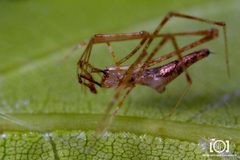
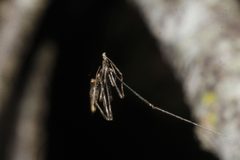
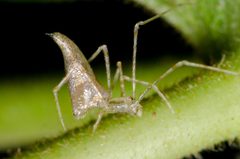
Rhomphaea is a of comb-footed spiders (Theridiidae) characterized by their distinctive elongated, stick-like bodies and specialized araneophagous predatory . These small spiders (4–5 mm) are found worldwide and are notable for their tactics, using triangular nets to capture other spiders on their own webs or by invading the webs of other . The genus is closely related to Ariamnes and is the sister group to Neospintharus within the Argyrodinae.
Pronunciation
How to pronounce Rhomphaea: /rɔmˈfaɪə/
These audio files are automatically generated. While they are not always 100% accurate, they are a good starting point.
Identification
Distinguished from related by the combination of: extremely elongated (four to six times longer behind than in front in females); first patella and tibia three to four times length; slanting projecting anteriorly with stridulatory ridges; and triangular net-throwing predatory . Closely related to Ariamnes but differs in abdominal shape and proportions. Distinguished from Neospintharus by being its sister group with subtle morphological differences in abdominal tapering and region projections.
Images
Habitat
Forest ; specimens have been collected by beating vegetation up to approximately two meters above ground. Found in diverse forest types including tropical and subtropical regions.
Distribution
Worldwide distribution. Documented from Sri Lanka (Kanneliya, Sinharaja, Nilgala forest, Ethagala, Sita Eliya, Kande Ela), Japan (Okayama Prefecture), and North America (Vermont, USA).
Diet
Araneophagy is the main foraging strategy; these spiders specialize in capturing other spiders. They have been observed to occasionally engage in kleptoparasitism. They capture spiders that wander onto their own webs and also venture onto other spiders' webs to capture the residents.
Behavior
Solitary and elusive. Employs to lure victim spiders. Uses a distinctive hunting technique: throwing a sticky triangular net over prey. Free-living rather than permanent web residents; actively hunts on their own webs and invades webs of other spider .
Ecological Role
Araneophagous specializing in spider ; may influence local spider structure through intraguild predation.
Similar Taxa
- AriamnesVery close taxonomic relationship; both share elongated body forms and belong to Argyrodinae, but differ in abdominal proportions and region structure
- NeospintharusSister group to Rhomphaea; both are monophyletic within Argyrodinae, distinguished by subtle morphological differences in abdominal tapering and geographic distribution patterns
Sources and further reading
- BugGuide
- Wikipedia
- GBIF taxonomy match
- iNaturalist taxon
- NCBI Taxonomy
- Catalogue of Life
- A new species of the genus Rhomphaea (Araneae: Theridiidae) from Okayama Prefecture, Japan, with notes on the habitats of Japanese Rhomphaea
- Origin and diversification of free-living stick spiders of Sri Lanka including the description of four new species of Rhomphaea L. Koch, 1872 and two new species of Neospintharus Exline, 1950