
Chrosiothes
Simon, 1894
Species Guides
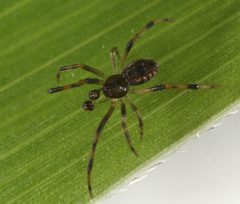
3Chrosiothes is a of comb-footed spiders in the Theridiidae, established by Eugène Louis Simon in 1894. The genus contains 27 distributed primarily in the New World, with most species occurring from the United States to Brazil. Males are noticeably smaller than females, with females of C. jamaicensis measuring approximately 2.9 mm compared to 1.6 mm for males. The genus is considered a senior synonym of Theridiotis.
Pronunciation
How to pronounce Chrosiothes: //ˈkroʊ.si.oʊˌθiːz//
These audio files are automatically generated. While they are not always 100% accurate, they are a good starting point.
Identification
Distinguished from related by the presence of two minute setae replacing the colulus, a structure found at the end of the in many theridiids. The combination of thick legs and reduced colulus separates Chrosiothes from Episinus, Spintharus, Thwaitesia, and Anelosimus, with which it is closely related. Male size reduction relative to females is more extreme than in many related theridiid genera.
Images
Appearance
Small comb-footed spiders with thick legs. The colulus is replaced by two minute setae. in body size is pronounced, with males substantially smaller than females.
Distribution
Almost exclusively New World, ranging from the United States to Brazil. Disjunct Asian distribution includes one (C. sudabides) in China, Korea, and Japan, and two species (C. fulvus, C. taiwan) in Taiwan.
Similar Taxa
- EpisinusClosely related ; distinguished by colulus structure and leg proportions
- SpintharusClosely related ; Chrosiothes differs in colulus reduction and leg thickness
- ThwaitesiaClosely related ; differs in abdominal ornamentation and colulus structure
- AnelosimusClosely related ; Chrosiothes lacks the social and nest-sharing common in many Anelosimus
More Details
Nomenclatural history
Chrosiothes is the senior synonym of Theridiotis. One , C. australis, was transferred to Episinus.
Species diversity
The underwent significant expansion with seven described in 2017 from Brazil by Puchulú-Figueiredo, Santanna & Rodrigues.