
Glenognatha
Simon, 1887
Species Guides
1- Glenognatha foxi(Dwarf Ground Long-jawed Spider)
Glenognatha is a of long-jawed orb-weaving spiders in the Tetragnathidae, first described by Eugène Louis Simon in 1887 and substantially revised in 2016. These are small spiders (3–5 mm) with distinctive elongated in males and a characteristic pear-shaped, dark, shiny . They construct horizontal, asymmetrical orb-webs with tight mesh and debris attachments, occupying a cryptic lifestyle in forest understory vegetation.


Pronunciation
How to pronounce Glenognatha: //ˌɡlɛn.oʊˈnæθ.ə//
These audio files are automatically generated. While they are not always 100% accurate, they are a good starting point.
Identification
Distinguished from other Tetragnathidae by the combination of small size (3–5 mm), pear-shaped and truncated , elevated region with smallest eyes, and absence of leg spines. Males are further identified by long, robust . The horizontal, asymmetrical orb-web with tight mesh and debris attachments resembles Uloborus webs, but Glenognatha belongs to Tetragnathidae rather than Uloboridae.
Images
Appearance
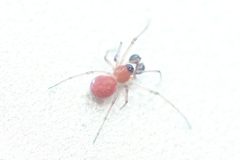
Small spiders with total length of 3–5 mm in both sexes. pear-shaped, dark and shiny, slightly punctuated, and truncated anteriorly. region elevated with eyes prominent in two rows; eyes smallest. round and shiny, usually with dark spots. Legs long, especially first two pairs, lacking spines. Males possess long, robust .
Habitat
Forest understory vegetation, sampled between leaves in the ground layer.
Distribution
North America, Central America, South America, the Caribbean, Africa, Asia, French Polynesian Islands, and Saint Helena.
Behavior
Constructs horizontal, asymmetrical orb-webs with tight mesh featuring closely set spirals and numerous . Attaches small pieces of debris to the web and hides beneath them when disturbed, adopting a cryptic posture.
Similar Taxa
- UloborusWeb architecture, , and cryptic posture are very similar; both construct horizontal asymmetrical orb-webs with debris attachments. Distinguished by placement (Uloboridae vs. Tetragnathidae) and morphological features including shape and male cheliceral .
More Details
Taxonomic revision
The was considerably revised in 2016, affecting circumscriptions and synonymies.